Painting & Protecting Concrete Floors: The Complete Guide for Garages, Basements & Utility Areas in Indian Homes
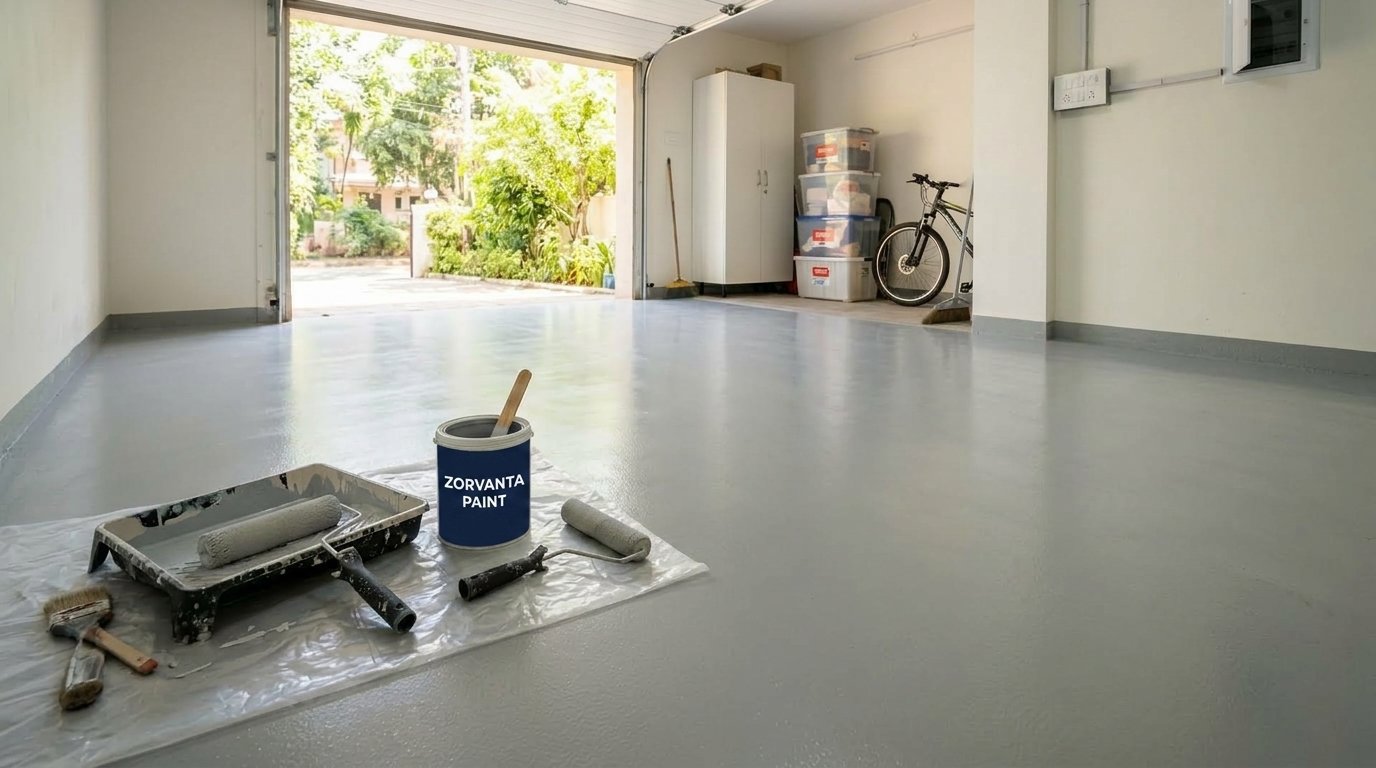
The concrete floor is almost always the last thing anyone thinks about when finishing or renovating an Indian home. Walls get carefully chosen colours, ceilings get a fresh coat of white, and the floor — that vast, hard-wearing, load-bearing slab that holds everything else up — is left bare, grey, and untreated. In living rooms and bedrooms, this is addressed with tiles or stone. In garages, basements, storerooms, utility rooms, and building service areas, the concrete is simply left exposed, and the assumption is that it does not need any further attention.
That assumption is costly. Bare, unsealed concrete is far less durable than its appearance suggests. It dusts — releasing a fine grey powder that settles on vehicles, stored items, and machinery. It stains permanently from oil drips, rust, and chemical spills. It absorbs water through capillary action from the slab beneath it, leading to damp patches and eventually to spalling and crumbling at the surface. In Indian conditions — with monsoon humidity, dramatic temperature swings, and hard groundwater — the deterioration of an untreated concrete floor accelerates significantly compared to the same surface in a temperate climate.
The good news is that concrete floors, treated correctly, become highly functional, durable, and visually clean surfaces that are easy to maintain, resistant to staining, and significantly longer-lived. This guide covers the full process: understanding what causes concrete floor failure, selecting the correct coating system for the specific use of the space, preparing the surface to the standard that allows the coating to perform correctly, and applying it in a way that delivers a finish which lasts.
Why Untreated Concrete Floors Fail: Understanding the Problem
Concrete is a strong structural material, but its surface is inherently porous and mechanically weak compared to the bulk of the slab. The thin surface layer — the laitance — is the weakest part of any concrete pour. It is formed by the fine cement particles and water that rise to the surface during curing, and it creates a surface that looks solid but is actually fragile, porous, and poorly bonded to the aggregate-rich concrete below it.
This surface laitance is the layer that dusts — the fine grey powder that you see on bare concrete garage floors. When vehicles drive over it, when foot traffic crosses it daily, and when anything is dragged across it, the laitance wears away progressively, releasing dust and creating a rough, uneven surface. No paint or coating applied over untreated laitance will bond reliably — the coating adheres to the weak laitance layer, and when the laitance fails, it takes the coating with it.
The second problem is moisture. Concrete is hygroscopic — it absorbs and holds moisture. In a basement or ground-level garage slab in India, moisture from the soil migrates upward through the slab continuously, driven by capillary pressure and vapour diffusion. This moisture reaches the surface and either evaporates there or, if a coating has been applied without adequate moisture management, builds up pressure behind the coating film and eventually causes blistering and delamination. In monsoon conditions, this upward moisture drive intensifies significantly.
The third failure mode is chemical attack. Garage floors are exposed to engine oil, battery acid, brake fluid, fuel drips, and cleaning chemicals. These agents are all aggressive to bare concrete — oils penetrate deeply and permanently stain the surface, acids etch the cement matrix, and solvents soften any standard paint that has been applied without chemical resistance in mind.
Choosing the Right Coating System: Matching Product to Use
The correct coating for a concrete floor depends almost entirely on the specific use of the space, the moisture condition of the slab, and the degree of chemical exposure expected. There is no single product that is correct for every situation — a basement floor in a humid Indian climate needs a different specification from a dry utility room, and a vehicle workshop needs something different from a domestic garage used mainly for storage.
Concrete sealers and penetrating primers are the foundation layer for almost every concrete floor coating system. A penetrating concrete sealer — based on silane, siloxane, or sodium silicate chemistry — does not sit on top of the concrete but soaks into it, reacting with the cement matrix to harden and densify the surface. This eliminates dusting, dramatically reduces porosity, and strengthens the surface laitance so that a topcoat applied over it has a sound substrate to bond to. A penetrating sealer alone, without any decorative topcoat, is a valid and effective treatment for utility rooms and storerooms where appearance is not a priority — it stops dusting, improves water resistance, and significantly extends the life of the surface without changing its colour or texture.
Epoxy floor coatings are the premium standard for domestic garages, vehicle workshops, and any floor that sees regular vehicle traffic, chemical spills, or heavy loads. Two-component epoxy floor paint — a resin base and a hardener catalyst mixed immediately before application — cures to a hard, impermeable, chemically resistant surface that is genuinely washable, stain-resistant, and durable under the wheels of cars and motorcycles. A good epoxy floor system on a well-prepared garage floor will last eight to twelve years before recoating is needed, and during that time it will resist oil stains, water, battery acid, and the daily abrasion of vehicle tyres without degrading. Epoxy is available in a range of colours and can be specified with decorative colour flakes broadcast into the wet coating for a non-slip, visually interesting finish.
Polyurethane (PU) floor coatings are the correct specification where chemical resistance and UV stability are the priority concerns. Epoxy floors, while chemically resistant, yellow under UV exposure — an issue for areas with significant natural light entry, such as an open-fronted garage or a covered car porch where sunlight reaches the floor. Polyurethane topcoats are UV-stable and maintain their colour under light exposure. For maximum performance, a two-coat system — epoxy primer and intermediate coat for chemical resistance and adhesion, with a polyurethane topcoat for UV stability and abrasion resistance — is the correct approach for demanding applications.
Acrylic floor paint is the entry-level option for utility rooms, storerooms, and basement areas that receive light foot traffic and no vehicle or chemical exposure. Acrylic floor coatings are water-based, low-odour, and easy to apply, and they provide a clean, coloured surface that is significantly easier to keep clean than bare concrete. They are not appropriate for vehicle traffic or chemical exposure, but for areas that simply need a sealed, cleanable surface at a modest budget, a quality acrylic floor paint over a penetrating concrete primer is a practical and effective choice.
Surface Preparation: The Step That Decides Everything
No coating for concrete floors is more forgiving of inadequate preparation than coatings for any other surface — and in the case of epoxy, the preparation requirements are considerably more stringent than those for wall paints. The failure of almost every concrete floor coating that peels, bubbles, or delaminates can be traced directly to inadequate preparation. The coating is often not at fault; the surface it was asked to bond to was simply not ready.
The first step is cleaning. All oil, grease, fuel residues, and chemical contamination must be completely removed before any primer or coating is applied. Oil that has penetrated the concrete surface must be treated with a chemical degreaser — scrubbed in, left to dwell, and then rinsed thoroughly. Any visible oil stain that remains after degreasing is a zone where the coating will not bond and will eventually fail. On older garage floors, this degreasing step may need to be repeated multiple times to reach a truly clean substrate.
The second step is laitance removal and surface profiling. The weak surface laitance must be mechanically removed, and the concrete surface must be given a texture — a profile — that allows the coating to bond mechanically as well as chemically. The two practical methods for achieving this on residential concrete floors are acid etching and mechanical grinding. Acid etching, using diluted hydrochloric acid or a proprietary concrete etch product, dissolves the laitance and opens the surface pores of the concrete, creating a texture similar to fine sandpaper. It is the accessible, lower-cost method for a homeowner tackling a garage floor preparation. Mechanical grinding with a diamond-disc angle grinder or a hired floor grinder removes laitance mechanically and produces a more consistent, controllable profile — it is the method used by professionals and is preferred for larger areas or surfaces with significant contamination.
The third step is moisture testing. Before any epoxy or polyurethane coating is applied, the concrete slab must be below a maximum moisture level — typically around 4% moisture content by weight, or a surface humidity below 75% relative humidity as measured at the surface. In Indian conditions, a slab that is damp from monsoon water table rise or from water entry at the walls can easily exceed this limit. A simple plastic sheet test — taping a 30 x 30 centimetre square of polythene sheeting to the floor for 24 hours and checking for condensation on the underside — will indicate whether significant moisture is present. If moisture is high, the slab must be allowed to dry, or a moisture-tolerant epoxy primer must be used as the first coat.
Fill all cracks, expansion joints, and surface defects with an epoxy crack filler or a polyurethane joint sealant before applying the main coating. Surface cracks that are filled with a flexible compound prevent water entry and stop the coating from bridging a movement crack and then splitting when the crack widens.
Application: Getting the Coating Right
Epoxy floor coatings are more demanding to apply than wall paints, and the specific requirements of two-component mixing, pot life management, and temperature sensitivity need to be understood before starting.
Mixing: Two-component epoxy products must be mixed in exactly the ratio specified on the product data sheet — deviation from this ratio prevents full curing and produces a coating that remains soft, tacky, or chemically incomplete. Mix the full specified quantities together in a clean bucket, using a power stirrer for the specified mixing time, and allow the mixture to stand for the induction period — typically five to ten minutes — before application. This induction period allows the chemical reaction to initiate properly and improves the final film properties.
Pot life: Mixed epoxy has a working life — the pot life — during which it must be applied. At 25°C, most epoxy floor coatings have a pot life of 30 to 45 minutes. In Indian summer conditions, with temperatures above 35°C, this reduces significantly. Work in manageable batches, and do not leave mixed material sitting in the bucket — pour it out and spread it promptly. Epoxy that has started to gel in the bucket cannot be thinned or revived; it must be discarded.
Application sequence: Apply the primer coat first, working it into the prepared concrete surface with a short-nap roller. Allow to cure to the specified recoat window — typically 12 to 24 hours at 25°C — before applying the intermediate and finish coats. Each coat should be applied within the manufacturer's recoat window; applying too late means the new coat cannot chemically bond to the previous one, reducing intercoat adhesion significantly. The minimum two-coat system — primer and topcoat — is the practical standard for residential garages. A three-coat system — primer, intermediate, and topcoat — provides additional film build and is appropriate for vehicle workshop floors or areas with sustained chemical exposure.
For the non-slip finish, broadcast colour flakes or anti-slip aggregate into the wet topcoat before it begins to cure, then seal with a clear epoxy or polyurethane topcoat to lock them in. This produces a floor that is both visually finished and provides genuine slip resistance underfoot — important in any area that may be wet from vehicle wash-down or rain entry.
Maintenance: Keeping a Coated Concrete Floor in Good Condition
A well-applied epoxy or polyurethane concrete floor coating requires minimal maintenance but benefits from simple, consistent care. Sweep regularly to remove grit and abrasive particles that accumulate from vehicle tyres — these particles act as fine sandpaper under foot and tyre traffic and are the primary cause of surface wear over time. Mop with a mild detergent solution monthly; avoid strong acid-based cleaning products, which can degrade the coating surface over time even on chemically resistant systems.
Address oil and chemical spills promptly. Even on a chemically resistant coating, extended contact with concentrated solvents or acids will eventually affect the surface. Wipe up spills as soon as possible, rinse the area with water, and dry. A floor that is cleaned after spills will remain in service significantly longer than one where spills are allowed to sit and penetrate at joints or imperfections in the film.
Inspect the floor annually for any areas where the coating has chipped, cracked, or delaminated. Small areas of damage addressed with a compatible patch coat prevent water entry and prevent the damage from spreading. A floor that is maintained this way will remain in serviceable condition for the full design life of the system — eight to twelve years for epoxy, potentially longer for PU topcoat systems — before a full recoat is needed.
The Zorvanta Approach to Concrete Floor Protection
At Zorvanta, we offer a complete floor coating range designed for Indian conditions — from penetrating concrete sealers that eliminate dusting on utility and storage floors, to two-component epoxy floor systems that deliver professional-grade vehicle workshop performance in a domestic garage setting. Our epoxy floor primer is formulated for Indian concrete quality and humidity conditions, with moisture-tolerant chemistry that allows application even when surface moisture levels are elevated by monsoon conditions. Our coloured epoxy topcoats are available in a practical range of floor colours, and our broadcast flake system delivers a finished floor with character and genuine slip resistance.
Whether you are sealing a storeroom floor that has dusted since the building was completed, coating a garage floor before parking a new vehicle, or specifying a full multi-coat system for a vehicle workshop, the investment in proper floor protection returns its cost many times over in the reduced maintenance, cleaning effort, and long-term structural protection it delivers. Explore our full floor coating range, read our guide on industrial floor coatings, or contact our team for a site-specific recommendation and quotation.
Frequently Asked Questions (FAQs)
1. Can I paint a concrete garage floor myself, or do I need a professional?
A domestic garage floor coating is achievable as a DIY project for a careful homeowner, provided the preparation steps — degreasing, acid etching, and moisture testing — are done correctly. The application of two-component epoxy is more demanding than wall painting, primarily because of the pot life and mixing requirements, but it is within the capability of anyone who follows the product data sheet carefully. Very large areas, floors with significant crack repair needs, or floors with persistent moisture problems are better handled by a professional applicator with mechanical grinding and moisture-testing equipment.
2. How long does an epoxy garage floor coating last in Indian conditions?
A correctly applied two-component epoxy floor system on a well-prepared concrete slab typically remains in service for eight to twelve years before recoating is needed. The primary factors that reduce this are inadequate preparation (laitance not removed, moisture too high), UV exposure on areas with direct sunlight (use a UV-stable PU topcoat in these areas), and failure to address oil spills and chemical contacts promptly.
3. What is the minimum curing time before I can drive on a freshly coated garage floor?
Light foot traffic is typically possible after 24 hours at 25°C. Vehicle traffic should not be attempted until at least 72 hours after the final topcoat, and ideally 5 to 7 days for full chemical cure. In cooler conditions — below 20°C — cure times extend significantly. Never drive on a freshly coated floor before the specified vehicle traffic cure time; tyre marks from premature use are permanent and cannot be removed without recoating.
4. My basement floor is always damp in the monsoon. Can I still coat it?
Yes, but a moisture-tolerant epoxy primer must be used as the first coat, and the floor must be as dry as practically achievable before application. The plastic sheet test will indicate how significant the moisture drive is. For basement floors with severe upward moisture, a penetrating silane or sodium silicate sealer applied first, allowed to cure for 7 days, and then overcoated with a moisture-tolerant epoxy system provides the best chance of a durable result. Floors with active water entry through cracks need the water entry point addressed structurally before any surface coating will hold.
5. Does the colour of floor epoxy affect the floor temperature in Indian summer?
Light-coloured epoxy floors — whites, light greys, beige — reflect more heat than dark colours and result in a cooler floor surface in direct sun. In an open-fronted garage or car porch that receives direct summer sun, a light-coloured floor coating reduces the surface temperature noticeably. Dark grey or charcoal epoxy floors in direct sun can become hot enough to soften tyres over time, particularly in intense Indian summer conditions in states like Rajasthan or Gujarat. Choose light colours for sun-exposed floors for both comfort and long-term tyre protection.
6. Can I apply floor epoxy over existing floor paint that is already peeling?
No. Applying any new coating over peeling, delaminating, or poorly bonded existing paint will produce a result that fails at the same rate as the existing paint — the new coating is only as good as what it bonds to. All existing paint that is not firmly bonded must be completely removed — by grinding, scraping, or chemical stripping — back to sound concrete before any new coating system is applied. Attempting to coat over failing paint is the single most common cause of new floor coating failure.
Need help choosing the right finish?
Talk to our team or request a tailored quotation for your project.