Industrial Floor Coatings: How to Choose the Right Epoxy & Anti-Slip Finish for Warehouses, Factories & Garages
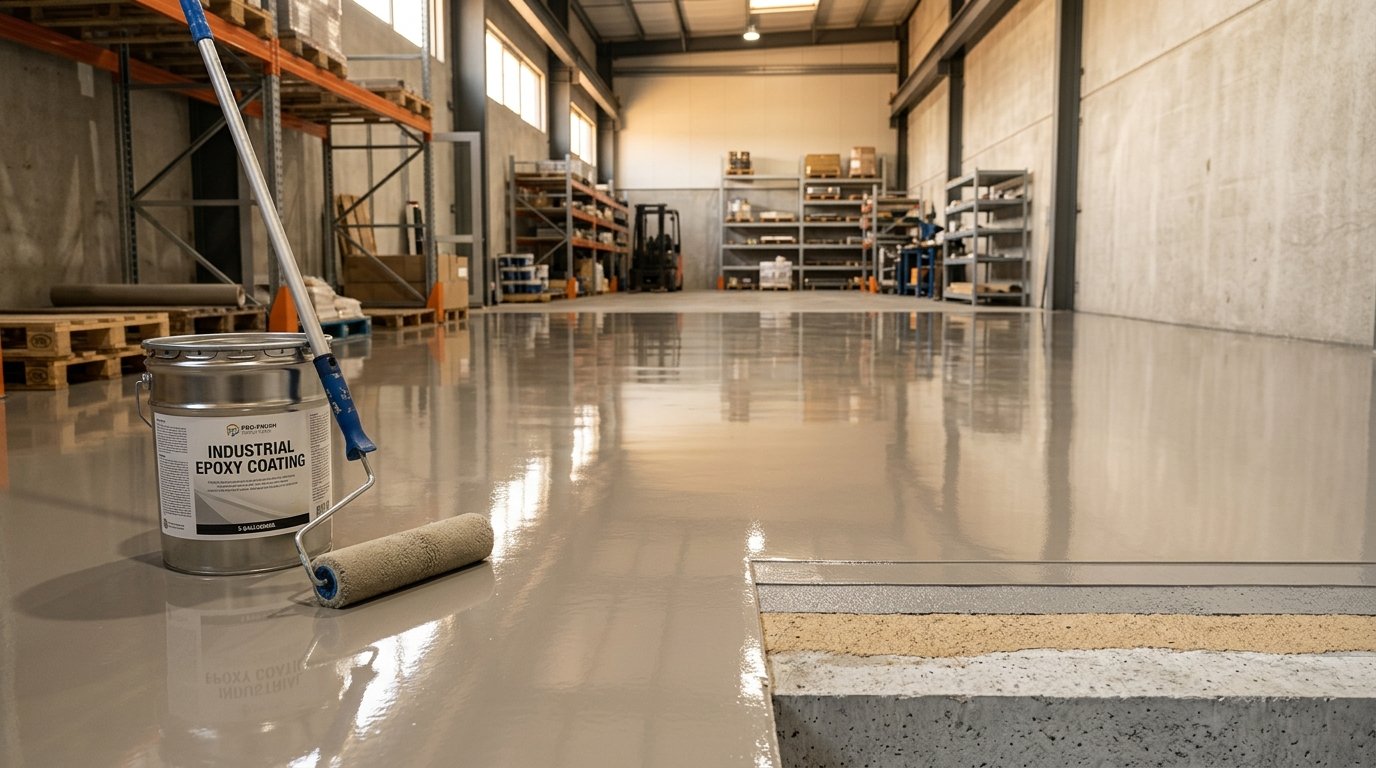
Walk into almost any warehouse, factory, or commercial garage in India and you will find one of two things: a bare concrete slab that is dusting, cracking, and accumulating grime in every surface pore — or a professionally coated floor that is clean, dust-free, clearly marked, and visibly easier to maintain. The difference between these two outcomes is not the quality of the original concrete pour. It is the decision to protect and finish the floor with a purpose-specified coating system.
Industrial and commercial floor coatings are not decorative products applied as an afterthought. They are performance systems that extend the life of the concrete substrate, eliminate surface dusting that contaminates machinery and products, create slip-resistant surfaces that protect workers, resist the chemical spills and solvent exposures that are routine in industrial environments, and provide clearly demarcated zones for traffic management, storage, and safety. Choosing the wrong system — or applying the right system incorrectly — results in premature failure, delamination, and costly downtime for remediation. Choosing and applying the correct system produces a surface that can outlast the machinery operating on it.
This guide covers every major category of industrial floor coating available in India, the specific conditions that determine which system is appropriate, the surface preparation that makes or breaks any coating, and the application process that determines whether a floor coating performs for two years or fifteen.
Why Concrete Floors Need Coating — And What Happens Without It
Raw concrete is a remarkable structural material, but as a finished floor surface it has significant weaknesses. The upper paste layer of a freshly poured concrete slab — the layer that the floor coating bonds to — is inherently porous, mechanically weak relative to the body of the slab, and susceptible to abrasion. Under foot traffic alone, uncoated concrete begins to dust within a few years. Under forklift tyres, pallet dragging, and dropped tools, the deterioration accelerates sharply.
Dusting concrete is not merely an aesthetic issue. Concrete dust is fine particulate that settles on machinery, contaminates sensitive manufacturing processes, and is a respiratory hazard in poorly ventilated spaces. In food processing, pharmaceutical, and electronics facilities, concrete dust is a disqualifying contamination risk. Even in general warehousing, the accumulation of concrete dust on product packaging, stored goods, and mechanically sensitive equipment is an ongoing operational problem.
Water and chemical penetration compound the issue. Uncoated concrete absorbs water, oils, solvents, and cleaning chemicals into its pore structure. Oil stains from machinery become permanent. Chloride ingress from cleaning agents attacks embedded reinforcement over time. Chemical spills in industrial environments — acids, alkalis, solvents, hydraulic fluids — begin the process of dissolving the cement matrix of the concrete surface, progressively deteriorating the floor from the first exposure.
The right floor coating addresses all of these failure modes simultaneously: it seals the surface against absorption, hardens and protects the wear layer, provides chemical resistance matched to the specific substances present, and does so with a surface that can be cleaned effectively and maintained efficiently.
The Major Categories of Industrial Floor Coating
Industrial floor coatings divide into several distinct chemistry families, each with specific performance characteristics, cost structures, and application requirements. Understanding the category landscape is the first step in specifying correctly.
Epoxy floor coatings are the workhorse of industrial flooring. A two-component system — epoxy resin and hardener — that is mixed immediately before application, epoxy coatings cure to a hard, chemically resistant film with excellent adhesion to concrete and outstanding resistance to oils, many solvents, and dilute acids and alkalis. They are available across a wide range from thin-film decorative floor paints at 100–200 microns dry film thickness to thick self-levelling epoxy systems at 2–3 millimetres that effectively resurface a deteriorated concrete slab.
Epoxy coatings are suited to warehousing, light manufacturing, automotive workshops, food processing facilities, pharmaceutical environments, and any space where chemical resistance and cleanliness are priorities. Their limitation is UV sensitivity — direct sunlight causes chalking and yellowing in epoxy topcoats over time, which makes them unsuitable as the finish coat in outdoor or sun-exposed areas unless overcoated with a UV-stable polyurethane.
Polyurethane floor coatings offer superior flexibility and UV resistance compared to epoxy. Where epoxy is hard and somewhat brittle, polyurethane is tough and resilient — it absorbs impact and deflection better, making it the preferred topcoat in heavy-duty applications where forklift traffic is heavy and floor flex under load is a concern. Polyurethane also maintains its colour and gloss far better under UV exposure, making it the correct choice for covered but naturally lit facilities, car parks, and any area with skylight or side-window solar exposure.
In high-performance systems, epoxy and polyurethane are combined: an epoxy primer and mid-coat for adhesion, chemical resistance, and build, topped with a polyurethane topcoat for UV stability, surface toughness, and aesthetic durability. This combination system delivers the best of both chemistries and is the standard specification for demanding industrial applications.
MMA (methyl methacrylate) floor coatings are the specialist choice when rapid return to service is a priority. MMA systems cure extremely fast — fully hard in 60 minutes at most temperatures — which makes them the specification for facilities that cannot afford extended downtime for floor installation: food production facilities, distribution centres, and any operation where floor areas cannot be taken out of service for the multiple days required by epoxy or polyurethane systems. MMA coatings also perform well at very low temperatures, unlike epoxy which will not cure correctly below 10°C.
Polyurea and polyaspartic coatings represent the newest chemistry in industrial flooring, combining the chemical resistance of epoxy with the UV stability of polyurethane and the fast cure of MMA. Applied by specialist contractors using two-component spray equipment, these coatings cure in minutes rather than hours. They are gaining ground in premium commercial and industrial applications, particularly in the automotive sector. Application requires specialist equipment and experience, which currently limits their penetration in the broader Indian market.
Concrete hardeners and densifiers are not coatings in the traditional sense — they are reactive chemical treatments that penetrate into the concrete surface and chemically react with the calcium hydroxide in the cement paste to produce a harder, denser surface with significantly reduced porosity and dusting. Lithium, sodium, and potassium silicate densifiers are used in warehouses where a gloss epoxy coating is unnecessary or too expensive, but where surface dusting and absorption must be controlled. A polished concrete floor treated with a densifier is a cost-effective, durable solution for large-area warehousing where aesthetics are secondary to function.
Anti-Slip Floor Coatings: A Safety Non-Negotiable
In any workplace — warehouse, factory, kitchen, garage, car wash, or public access area — slip resistance is not a performance nice-to-have. It is a safety requirement and, in most commercial and industrial contexts, a legal obligation under Indian occupational health and safety standards. A standard smooth epoxy floor can become dangerously slippery when wet, oily, or contaminated with fine dust.
Anti-slip floor coatings address this through two primary mechanisms. The first is aggregate incorporation: fine silica sand, aluminium oxide grit, or polymer microspheres are broadcast into the wet topcoat or pre-blended into the coating before application, creating a textured surface that provides mechanical grip under foot and tyre. The aggregate size and broadcast rate determine the level of slip resistance — from a light texture for pedestrian traffic to a coarse, aggressive texture for areas with oil contamination or wet process conditions.
The second mechanism is the use of textured roller application: a medium-nap roller applied to a standard epoxy or polyurethane topcoat creates a stipple texture that provides a degree of slip resistance without the harshness of an aggregate finish. This approach is appropriate for light-to-moderate traffic areas where cleanability and appearance are also considerations.
In Indian industrial settings, anti-slip specification is critical in areas adjacent to washing bays, chemical dispensing points, loading docks exposed to rain, cold stores where condensation forms on floors, and anywhere that oils, greases, or process liquids are routinely present on the floor surface. The coefficient of friction required by safety standards in these areas is specific, and the anti-slip coating specification should reference measurable slip resistance data — Rz values for textured surfaces, or Pendulum Test Values for smooth coatings under different contamination conditions.
Surface Preparation: The Factor That Determines Whether a Floor Coating Fails or Lasts
No other variable in a floor coating project has more influence over the long-term performance of the installed system than surface preparation. Every reputable manufacturer of industrial floor coatings will state clearly that inadequate surface preparation is the primary cause of floor coating failures. This is not a disclaimer — it is a practical reality of how floor coatings work.
A floor coating film is only as strong as its adhesion to the concrete substrate. Adhesion depends on three conditions: the surface must be mechanically sound, it must be free of all contaminants, and it must be open and profiled to allow the coating to key into the surface. Any failure in these three conditions results in a coating that looks complete at application but will delaminate — either progressively from a weak edge or suddenly in large sheets — within the first year of use.
Mechanical preparation of the concrete surface is typically achieved by shot blasting — a process in which steel shot is propelled at the concrete surface at high velocity to remove laitance, open pores, and create the surface profile that the coating adhesion requires. Shot blasting is the industry standard for any new floor coating on existing concrete and for any floor coating of a substrate that has previous surface contamination, oil impregnation, or laitance. Diamond grinding achieves similar results and is used where the geometry of the space makes shot blasting equipment difficult to deploy — tight corners, areas around columns, or spaces with low headroom.
For new concrete slabs, a minimum concrete age of 28 days is required before coating — the concrete must have completed its primary curing cycle before the coating is applied. Residual moisture in the concrete is one of the most common causes of epoxy floor coating failure in India: moisture trapped beneath a low-permeability epoxy film creates vapour pressure that lifts the coating from the surface in blisters and bubbles. In high-humidity monsoon conditions, concrete moisture content must be verified with a reliable measurement method — a surface moisture meter or calcium chloride test — before application begins.
Floor Marking, Zone Demarcation, and Safety Striping
In warehouses and factories, colour and marking are as important as the coating performance itself. Effective floor marking reduces accidents, improves logistics efficiency, and communicates spatial organisation to workers and visitors without the need for additional signage. The standard approach is to apply the base field colour in the primary floor coating and then use contrasting stripe colours — typically yellow for traffic lanes, white for pedestrian walkways, red for fire equipment zones, and green for emergency exits and evacuation routes — applied as a secondary coat over the cured base.
Line marking paint for industrial floors is a dedicated product category — typically a one-component, fast-drying solvent or water-based coating that can be applied with a line-marking machine for crisp, consistent widths. For the most durable marking, particularly in high-traffic forklift zones, the stripe is applied as a coloured epoxy rather than a decorative line marking paint, giving it the same wear resistance as the field coating.
Zone colours should follow a consistent, documented system across a facility so that the meaning of each colour is unambiguous. Where international standards are relevant — facilities with export customers or multinational operational standards — the colour coding system should reference the applicable standard to ensure consistency with global practice.
How to Choose the Right System for Your Specific Application
The correct floor coating specification depends on four primary factors: the type of traffic, the chemical exposure, the thermal environment, and the required cleanliness standard. Working through each factor systematically produces a specification that is matched to the actual conditions rather than over-specified in areas where a simpler system would serve, or — more dangerously — under-specified in critical zones.
For light to medium warehousing with pedestrian and occasional light forklift traffic and no chemical exposure, a two-coat epoxy system at 250–350 microns total dry film thickness over a properly prepared substrate will give five to eight years of service life. For heavy forklift traffic, chemical exposure, or a need for UV stability, a three-coat epoxy-polyurethane system at 500 microns or greater is the minimum correct specification. For food processing or pharmaceutical areas requiring seamless, hygienic surfaces impermeable to bacteria and suitable for hot-water washing, a self-levelling epoxy system at 2–3 millimetres with coved skirting details is the standard.
Car parks and parking structures present specific requirements: the floor must resist the combination of tyre scuffing, de-icing salt (in northern India's winter months), fuel and oil, and constant UV exposure in open-sided structures. Polyurethane systems with UV-stable topcoats and inherent toughness are the correct specification. In multi-storey car parks, waterproofing of the parking deck itself — to prevent water carrying salt into the slab and corroding reinforcement — is as critical as the wearing surface, and a waterproofing membrane under the topcoat is part of the correct system.
The Zorvanta Approach to Industrial Floor Coatings
At Zorvanta, our industrial floor coating range covers the full spectrum from concrete hardeners and single-component floor paints for light-duty applications through to high-build self-levelling epoxy systems and polyurethane topcoats for the most demanding industrial environments. Our technical team is experienced in specifying floor systems across industries — from food processing facilities requiring hygienic seamless finishes to automotive workshops requiring chemical-resistant, anti-slip surfaces — and in matching the system to the actual conditions of the specific floor rather than applying a generic specification.
We supply floor coatings backed by technical datasheets with clearly stated chemical resistance data, measured slip resistance values, and application parameters that allow contractors and facilities teams to apply the product correctly and get the claimed performance. Explore our full industrial coatings range, or read our companion guides on surface preparation, protecting metal surfaces from corrosion, and heat-resistant coatings for industrial environments. For a floor coating specification matched to your facility and a quotation that covers materials and technical support, contact our team or request a quotation online.
Frequently Asked Questions (FAQs)
1. How long does an epoxy floor coating last in a warehouse?
A properly specified and correctly applied two-component epoxy system over a shot-blasted concrete substrate will typically give five to eight years of service in moderate warehousing conditions before refinishing. In heavy forklift traffic areas with chemical exposure, a higher-build system at greater film thickness is required, and maintenance recoating of worn areas extends total system life significantly beyond the base specification.
2. Can epoxy floor coating be applied in the monsoon?
Monsoon conditions present two challenges for epoxy floor coatings: high ambient humidity affects the surface moisture content of the concrete and slows the curing of the epoxy, which can lead to surface tackiness, amine blush, and reduced performance. Concrete moisture content should be verified before application regardless of season, and epoxy should not be applied to surfaces with moisture content above the manufacturer's stated maximum. In the monsoon, this typically means morning application on concrete that has been protected from overnight rain, with dehumidification in enclosed spaces.
3. What is the difference between a floor hardener and a floor coating?
A concrete hardener — also called a densifier — is a chemical treatment that penetrates into the concrete and reacts with the cement to produce a harder, denser, less dusty surface. It does not produce a surface film. A floor coating is a film-forming product that creates a layer over the concrete surface. Hardeners are used where minimal intervention is required; coatings are used where sealing, chemical resistance, specific colour, or a hygienic surface is required. In many specifications, a hardener and a thin-film coating are used together — the hardener strengthens the substrate, and the coating provides surface performance.
4. Do I need an anti-slip coating in a dry warehouse?
Even in a nominally dry warehouse, slip resistance should not be ignored. Loading dock areas are exposed to rain during deliveries. Battery charging areas may have acid spill risk. Cleaning operations will wet the floor regularly. A light aggregate texture broadcast into the topcoat provides meaningful slip resistance without significantly affecting cleanability and is a prudent standard specification for any occupied industrial or commercial floor regardless of the primary environment.
5. How thick should an epoxy floor coating be?
Film thickness requirement depends on the application. Light-duty decorative epoxy floor paints may be applied at 100–150 microns dry film thickness. Standard industrial epoxy systems are typically specified at 250–500 microns total dry film thickness over a primed concrete surface. Self-levelling epoxy systems for hygienic and heavy-duty applications range from 1.5 to 3 millimetres. Applying below the minimum specified film thickness is one of the most common causes of premature floor coating failure — the thin film simply does not have the wear resistance to survive the actual traffic conditions.
6. Can I apply a new epoxy coating over an old, worn floor coating?
Recoating over an existing floor coating is possible in some circumstances, but requires careful assessment. The existing coating must be firmly bonded to the concrete — any delaminating or lifting areas must be removed before recoating. The existing coating surface must be abraded to provide a mechanical key for the new coat, and compatibility between the existing and new coating systems must be verified. In many cases where an existing epoxy has failed or is heavily worn, complete removal by grinding is a better long-term investment than recoating over a compromised surface.
Need help choosing the right finish?
Talk to our team or request a tailored quotation for your project.