Garage & Parking Area Wall Painting Guide: Durable, Oil-Stain Resistant Coatings for Indian Homes
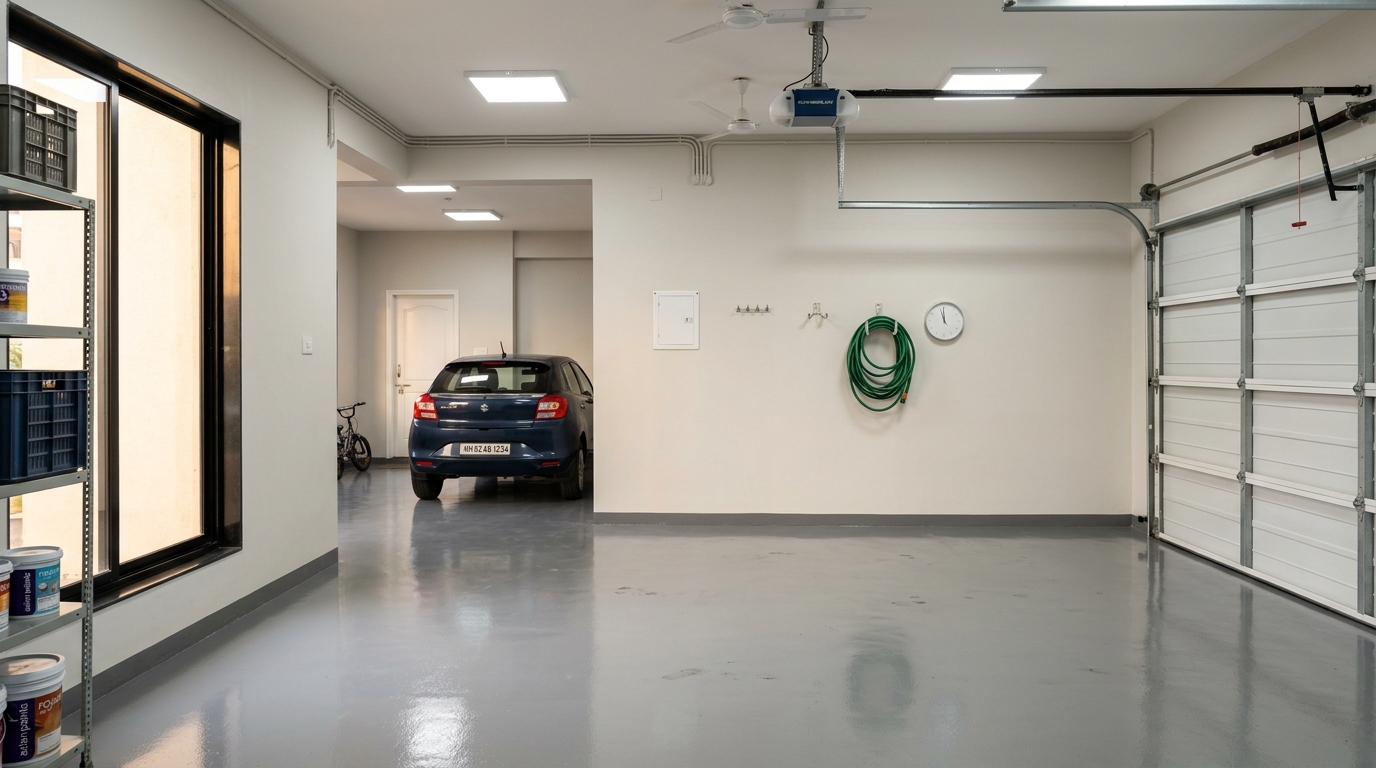
In the hierarchy of home spaces that receive careful paint attention, the garage and covered parking area sits firmly at the bottom. The living room gets colour consultation, the master bedroom gets a feature wall, the kitchen gets moisture-resistant coatings — and the garage gets whatever emulsion was left in the bucket after the rest of the house was done. The result is predictable: within six to twelve months, the garage walls are a catalogue of everything that standard interior paint cannot handle — grease marks from the car boot, tyre rubber transferred during tight turns, diesel and petrol exhaust staining at bumper height, water seepage creeping up from the floor junction, and a general grey discolouration that makes the entire space feel damp and neglected.
This outcome is not inevitable. A garage or covered parking area that is correctly specified and painted at the outset — with the right primer, the right paint system, and proper surface preparation — can look professional and clean for five to seven years with minimal maintenance. The difference in material cost between a proper garage paint specification and the leftover emulsion approach is modest. The difference in long-term performance is substantial.
This guide covers every aspect of getting that result right: the specific challenges of the garage environment in Indian homes, the paint systems engineered to address them, the surface preparation sequence that determines whether the finish lasts or fails within months, and the application details that separate a professional outcome from a disappointing one.
Understanding the Garage Environment: What Your Walls Are Actually Up Against
Before selecting any paint or primer, it is worth understanding precisely what a garage wall in an Indian home experiences that a living room wall does not. This environment has four defining characteristics that dictate the entire paint specification.
Vehicle exhaust and combustion residues are the most pervasive challenge. Every time a car or two-wheeler is started inside an attached garage or covered parking bay, the exhaust produces a fine aerosol of soot particles, unburnt hydrocarbons, and nitrogen oxides that deposit on every nearby surface. Over months and years, this deposit builds into a greasy, tenacious film — darker near the exhaust pipe level, lighter higher up, but present across the entire wall surface. On a standard matte emulsion, this film bonds directly into the porous paint matrix and cannot be wiped clean. It can only be painted over. A hard, low-porosity finish coat — engineered with sufficient cross-linked resin content — allows this deposit to be jet-washed or scrubbed off before it sets permanently.
Oil, grease, and mechanical fluid contamination is the second major factor. In Indian households, the garage is not merely a parking space — it doubles as the household workshop, the space where the car is serviced by the roadside mechanic, where tyres are changed, where motorcycles are chain-lubricated and maintained. These activities introduce engine oil, chain grease, brake fluid, and coolant onto the floor and, through splatter, onto the lower sections of the surrounding walls. These petroleum-based substances are aggressive to organic paint binders — they penetrate porous paint films, cause swelling and adhesion loss, and create permanent staining that bleeds back through any topcoat applied over it. The solution is two-part: a solvent-resistant epoxy or alkyd-modified primer that seals the surface against oil penetration, topped with a paint system that can be cleaned with a solvent wipe without damage.
Moisture from floor washing and ground-level seepage is a problem particular to Indian garages, where daily hosing of the car is the norm and the floor-to-wall junction is rarely sealed adequately in residential construction. The lower 600mm of a garage wall in a typical Indian home experiences repeated wetting from floor wash water, rising dampness from the concrete slab, and condensation from cold car bodywork in humid weather. Standard interior emulsions, even those marketed as moisture-resistant, are not engineered for this level of repeated direct water contact. The paint film delaminates, bubbles, and peels within months from the bottom up — the classic sign of an under-specified garage wall finish.
Impact and abrasion from car doors, bicycle handlebars, stored tools, and general workshop activity rounds out the challenge profile. Garage walls sustain a level of mechanical contact that living room walls simply never experience. A paint film without adequate hardness will show scuffs, scratches, and surface abrasion within months. A properly cross-linked or high-binder paint system resists this class of damage significantly better.
Surface Preparation: The Step That Determines Everything
The most sophisticated paint system in the world will fail prematurely if applied over poorly prepared surfaces. In a garage environment, where the walls are frequently contaminated with grease, oil, and exhaust residue from previous use, surface preparation is more demanding than in any living space — and more consequential if skipped or rushed.
Begin with a thorough degreasing wash. Mix trisodium phosphate (TSP) cleaner — or a concentrated heavy-duty alkaline degreaser — in warm water at the manufacturer's recommended dilution and scrub the entire wall surface with a stiff bristle brush. Pay particular attention to the lower 1 metre of wall, the area directly behind where vehicle exhausts typically point, and any zones where tools or equipment are stored against the wall. The degreasing wash does not remove the staining — it breaks the bond between the greasy film and the wall surface, allowing subsequent rinsing to remove the contamination. Rinse thoroughly with clean water and allow 48 hours to dry completely before proceeding.
If the existing paint is peeling, flaking, or showing bubbled sections, remove all loose material with a scraper and a stiff wire brush. In a garage with significant moisture exposure history, any bubbling paint is a sign of moisture trapped behind the film — painting over it without removing it guarantees that the new coat will bubble in the same locations within months. Remove all loose paint back to a firm, stable edge.
Fill cracks and holes with a cement-based patching compound or epoxy filler for areas with heavy moisture exposure. Unlike the lightweight acrylic fillers suitable for living room walls, garage repairs benefit from the higher compressive strength and moisture resistance of a cement-based or two-part epoxy filler. Mix per instructions, apply flush with a filling knife, and allow to cure fully before sanding smooth.
For bare concrete or block walls — common in converted garages and standalone parking structures — sand the entire surface lightly with a coarse sanding block to remove any surface laitance (the chalky, dusty surface layer on aged concrete that prevents adhesion). Wipe down with a tack cloth or dry microfiber to remove all dust before priming.
Choosing the Right Primer: The Foundation of a Lasting Finish
For garage and parking area walls, the primer selection is more critical than in any other domestic painting context, because the primer must simultaneously address several distinct substrate challenges.
On concrete and masonry garage walls, use a deep-penetrating alkali-resistant acrylic primer as the base coat. Concrete is an alkaline substrate — its high pH can cause saponification (soap formation) in organic paint binders that contact uncured concrete, leading to adhesion failure and colour discolouration. An alkali-resistant primer creates a chemical barrier between the concrete and the decorative topcoat, preventing this reaction and ensuring that the topcoat adheres uniformly across the entire surface.
In zones with confirmed oil contamination — the lower walls behind parking bays, areas near inspection pits or workshop areas — apply a shellac-based or solvent-based stain-blocking primer before the standard alkali-resistant coat. Oil staining in concrete is highly mobile — it wicks upward and sideways through the concrete matrix over time. Without a solvent-resistant barrier coat, oil will migrate through a standard acrylic primer and bleed through the topcoat within six to twelve months of application. A single coat of shellac primer over oil-contaminated zones seals the stain permanently and provides a sound base for subsequent coats.
For previously painted surfaces in sound condition (no peeling, no bubbling, no surface contamination beyond what has been cleaned), a quality multi-surface bonding primer applied over the cleaned, sanded surface provides adequate adhesion for the topcoat without the need for full paint removal.
Paint Systems for Garage Walls: What Works and What Does Not
The topcoat selection for garage walls should be guided by the actual performance demands of the environment, not by the same criteria applied to living spaces.
Exterior masonry paint applied to interior garage walls is a cost-effective and genuinely practical choice for attached garages and covered parking areas in Indian homes. Exterior masonry paints are formulated for a more demanding environment than any interior emulsion: they are engineered to resist UV, rain, biological growth, and direct water contact. Applied to the interior of a garage, that same durability translates to excellent resistance to the moisture, abrasion, and light cleaning demands of the garage environment. They are breathable, moisture-resistant, and hard-wearing. The finish is typically a low-sheen or semi-matte that does not attract marks visually the way a gloss surface would.
Semi-gloss or high-sheen interior emulsion is a better choice than standard matte for garage walls where washability is the primary concern and the moisture and oil contamination levels are moderate — for example, in a covered parking bay attached to an apartment flat where servicing is never carried out. The higher resin content of a semi-gloss or silk finish creates a harder, less porous surface that resists the day-to-day exhaust deposit and general grime of a parking space and can be wiped clean with a damp cloth or light scrubbing.
What to avoid: standard interior matte emulsion is the single worst choice for a garage or parking area wall, despite being the most commonly used. Matte emulsions are high-PVC (pigment volume concentration) formulations with relatively low binder content — they are deliberately engineered to be porous, which is what gives them their flat, velvety appearance and easy touch-up characteristic. That porosity, so desirable in a bedroom, is a liability in a garage: it absorbs oil, exhaust deposits, and moisture without possibility of recovery. Do not use matte emulsion on garage or parking area walls.
Colour Selection for Garages: Practical Over Aesthetic
The garage is the one domestic space where colour selection should be primarily practical rather than aesthetic. White and near-white tones — warm off-white, light grey, pale stone — remain the most popular choices for Indian home garages for reasons beyond taste: they maximise light reflection in what is typically a poorly lit space, making the garage significantly more functional and visually larger. A garage with white or near-white walls and a single fluorescent fitting reads as bright and usable. The same garage painted in a dark tone reads as dim and oppressive regardless of the lighting level.
Light cool grey — a tone with a slight blue or green undertone — is increasingly popular in Indian home garages and covered parking areas because it hides minor dust and exhaust discolouration better than pure white while maintaining the brightness benefit. A mid-tone warm grey in the 30 to 40% darkness range is the practical sweet spot: light enough to maximise reflectivity, just deep enough to mask the inevitable surface soiling between cleaning cycles without looking grubby.
Avoid the temptation to use dark accent colours on garage walls. They save nothing — the difficulty and cost of painting dark walls is essentially identical to painting light ones — and they create a space that feels smaller, darker, and harder to work in. Reserve dark or bold colour for garage doors or accent zones if a design statement is desired.
Application Tips for Garage Walls in Indian Conditions
Garage painting in Indian conditions — particularly during the pre-monsoon or early monsoon season — requires attention to humidity and ventilation that is less critical in air-conditioned living spaces.
Never apply paint to garage walls when ambient humidity exceeds 85%. At very high humidity, the water in water-based emulsions evaporates slowly and unevenly, causing uneven film formation, extended drying times, and in severe cases, a soft paint film that never achieves full hardness. If garage painting must be done during the monsoon season, work in the early morning before humidity peaks, keep the garage door open to maintain air movement, and allow significantly extended drying time between coats — at least 6 hours in high humidity rather than the standard 4.
Apply the primer coat first and allow it to dry overnight before the first topcoat. In a garage environment, where the substrate porosity and contamination levels are variable, rushing the primer dry time is a common cause of topcoat adhesion failure. The primer needs to fully penetrate the substrate and form a complete film before the topcoat can bond to it properly.
Use a short-nap roller (6mm to 9mm) for the flat wall areas and a quality brush for all the cut-in work at the floor junction, ceiling line, and around electrical fittings. The floor junction in particular — the most moisture-exposed zone — should be cut in carefully with a brush to ensure full paint coverage right to the floor level, where a roller invariably leaves a gap.
The Zorvanta Approach for Garage and Parking Area Walls
At Zorvanta Paints, we understand that the garage is a working space that demands working paint — not the same specification as a bedroom wall dressed up in a functional-sounding name. Our recommended system for Indian home garages begins with our Zorvanta Acrylic Deep Penetrating Primer — a deep-penetrating alkali-resistant primer formulated for concrete and masonry substrates — followed by two full coats of our PU Enamel Pro in a semi-gloss finish, which delivers the combination of hardness, washability, and durability that a garage environment demands. For zones with confirmed oil contamination, we recommend our stain-blocking shellac primer as an intermediate coat before the standard primer application.
Our team can advise on the specific primer and topcoat combination appropriate for your garage — whether it is an attached single-car garage in a Bengaluru villa, a basement parking area in a Mumbai apartment complex, or a covered two-wheeler bay in an Ahmedabad row house. The specification varies based on moisture exposure, vehicle type, and existing surface condition. Explore our full product range, read our guide on concrete floor painting for garages and utility areas, or contact our team for a site-specific consultation and quotation tailored to your garage painting project.
Frequently Asked Questions (FAQs)
1. Can I use regular interior emulsion paint on my garage walls?
Regular matte interior emulsion is not recommended for garage or parking area walls. It is too porous to resist oil staining, exhaust deposits, and repeated moisture contact. Use an exterior masonry paint or a semi-gloss/silk interior emulsion over a proper alkali-resistant primer for a durable, washable result.
2. How do I remove oil stains from garage walls before painting?
Scrub oil-stained areas with a heavy-duty alkaline degreaser or TSP (trisodium phosphate) solution using a stiff brush. Rinse thoroughly and allow to dry. Apply a shellac-based stain-blocking primer over any residual oil staining before your standard primer and topcoat — this permanently seals the oil and prevents it from bleeding through the decorative finish.
3. What is the best colour for garage walls in an Indian home?
Light warm grey, off-white, or pale stone tones are the most practical choices. They maximise light reflectivity in a space that is often poorly lit, hide minor soiling between cleaning cycles, and create a clean, functional atmosphere. Avoid dark colours that make the garage feel smaller and harder to work in.
4. How often should garage walls be repainted?
A properly specified garage wall — alkali-resistant primer plus two coats of semi-gloss or exterior masonry paint — should hold its appearance for five to seven years with periodic washing. The most common reason for earlier repainting is using the wrong paint system initially: matte emulsion in a garage environment typically needs repainting within two to three years as staining and moisture damage accumulate beyond recovery.
5. Do I need special preparation for a garage wall that has been painted before?
Yes. Degrease the entire surface thoroughly before anything else — existing paint in a garage is contaminated with exhaust residue and grease even if it does not look visibly dirty. Remove all peeling or bubbling paint back to firm edges. Lightly sand the sound painted areas to improve adhesion. Then apply a bonding primer before the topcoat. Skipping the degreasing step is the most common cause of new topcoat adhesion failure on previously painted garage walls.
Need help choosing the right finish?
Talk to our team or request a tailored quotation for your project.