How to Choose the Right Exterior Wall Paint: A Complete Guide for Indian Homes
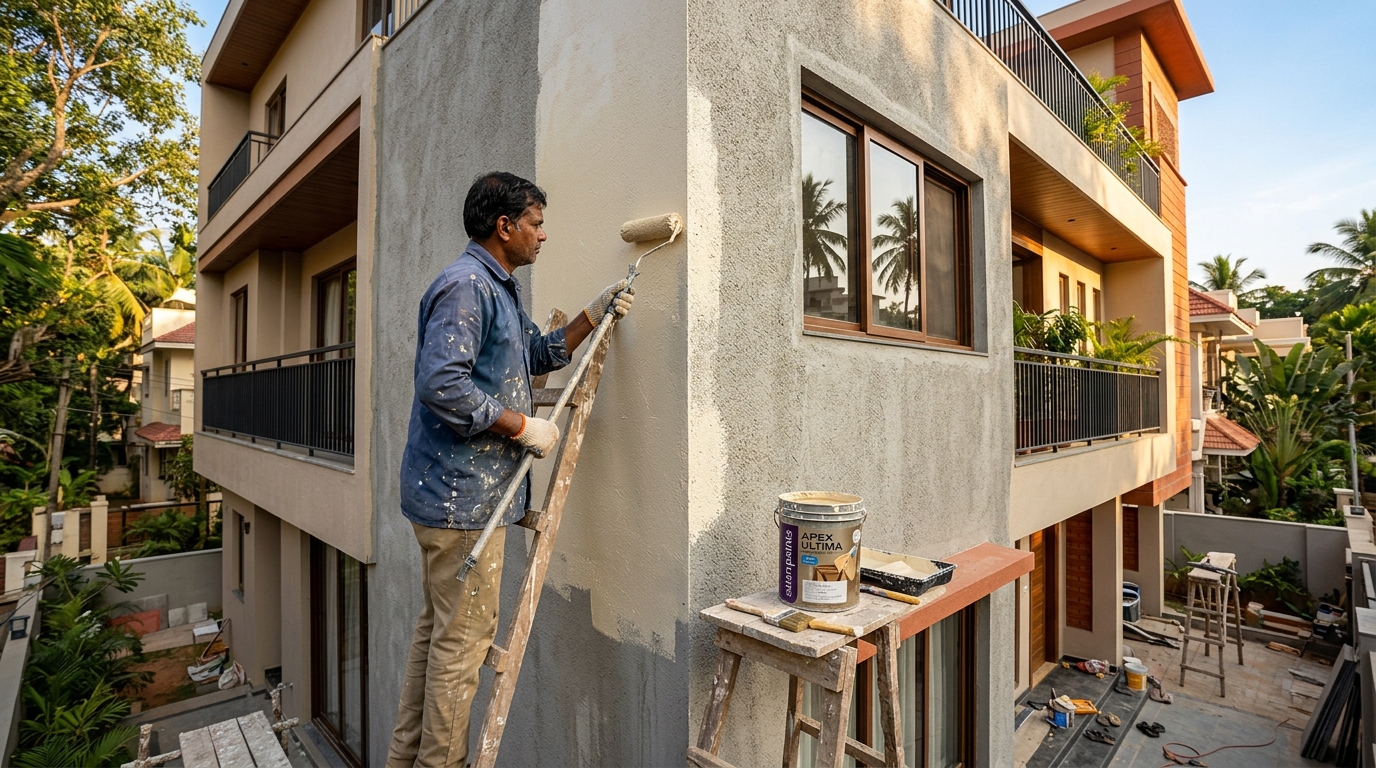
Of all the decisions involved in painting or repainting an Indian home, choosing the exterior wall paint is the one that demands the most careful thinking — and receives, on average, the least. The interior gets colour consultations, finish deliberations, and brand comparisons. The exterior gets whatever the contractor recommends, or whatever the hardware store has in stock at a familiar price point. The results of this asymmetry are visible on the facades of nearly every residential street in India: paint that has chalked within two monsoons, colour that has faded from the sun side while the shade side stays relatively vibrant, bubbling and delamination along the plinth, and hairline-crack staining on textured surfaces that turns a textured wall into a map of every fault line in the render beneath.
These outcomes are not inevitable consequences of the Indian climate — they are consequences of the wrong paint system for the Indian climate. Getting the exterior paint selection right from the outset is the single most effective step toward an exterior that looks well-maintained, holds its colour, and does not require repainting every three years out of necessity rather than choice.
This guide covers every factor in that selection: the paint technologies available, the finish options and when each is appropriate, the primer choices that determine whether the topcoat performs or fails, the colour decisions that affect long-term appearance, and the application sequencing that turns a good specification on paper into a good outcome on the wall.
Understanding What Your Exterior Wall Actually Faces
The first step in choosing the right exterior paint is an honest assessment of what the wall will experience. In India, this is not a uniform answer — the climate conditions that govern paint performance vary dramatically between a house in coastal Kochi, a bungalow in the Rajasthan desert, an apartment in the Delhi NCR, and a villa in Pune. A paint system designed to handle 3,000 mm of annual rainfall and persistent coastal humidity is a different specification from one needed for a dry, UV-intense desert exterior with minimal moisture but extreme thermal cycling. Both of these are different again from a Bengaluru exterior that spends six months a year in moderate humidity and six months in near-perfect painting weather.
Rain and moisture exposure is the primary stressor for exterior paint in most of India. The monsoon delivers sustained driving rain over weeks and months, and the wall must cope with this water without absorbing it, blistering, or developing mould and algae colonies. Paint technology has advanced significantly in addressing this — modern elastomeric and silicone-modified exterior paints form a continuous, slightly flexible film over the wall surface that channels water away rather than absorbing it — but the baseline protection level varies enormously between a standard exterior emulsion and a properly formulated weatherproof masonry coating.
UV intensity is the second major factor and the one most commonly underestimated. India's UV index across most of the country exceeds levels seen in most of Europe for the majority of the year. UV radiation degrades organic paint binders and bleaches pigments — the mechanism responsible for both the chalking of exterior walls (binder degradation releasing loose pigment particles to the surface) and the fading of exterior colour (pigment photodegradation). Paints formulated with UV-stabilised pigments and higher-quality acrylic or silicone-modified binder systems resist both processes significantly better than standard emulsions applied to the exterior.
Thermal cycling — the daily expansion and contraction of a masonry wall as it heats in the sun and cools at night — creates micro-stress in any coating applied to it. Over years, paint with insufficient elongation (flexibility) cracks along these stress lines, creating a network of hairline cracks that trap dirt, water, and biological growth. Elastomeric exterior paints address this directly: they are formulated with enough film flexibility to stretch with the wall rather than cracking against it.
The Four Main Exterior Paint Technologies — and When to Use Each
Once you understand what your wall faces, you can match it to the right paint technology. There are four main categories relevant to Indian residential exteriors, each occupying a different position on the performance-versus-cost spectrum.
Standard exterior acrylic emulsion is the most widely used exterior paint in Indian residential construction, primarily because it is the most affordable category. It offers basic weather resistance, reasonable colour retention for two to three years, and adequate protection for walls that are not exposed to extreme moisture or UV conditions. For a home in a low-rainfall zone, north-facing walls with significant shade exposure, or a project with a limited budget, a quality exterior acrylic emulsion from a reputable brand applied over a proper primer is a defensible choice. It is not the best choice — but applied correctly over a sound, prepared surface, it performs adequately and will not fail dramatically within a normal repaint cycle.
Elastomeric exterior coatings represent the category that most Indian homeowners should be specifying but rarely do. These coatings contain a higher proportion of flexible acrylic binder that gives the cured film the ability to bridge minor cracks in the masonry beneath and to stretch with thermal expansion without fracturing. For walls with any history of hairline cracking, for homes in high-rainfall zones, or for any exterior that has previously shown water ingress at the facade, an elastomeric coating is the correct specification. The material cost is meaningfully higher than standard exterior emulsion — but the performance difference over a five-to-seven-year period is substantial enough that the cost-per-year of protection is often comparable or lower.
Silicone-modified exterior paints are a newer category in the Indian market, well-established in European and Japanese exterior paint formulation, and becoming increasingly available through quality paint suppliers in Indian cities. Silicone modification of the acrylic binder significantly enhances water repellency — the cured film creates a surface that causes water to bead and run off rather than forming a sheet across the wall — while maintaining breathability (allowing moisture vapour from inside the wall to escape outward). This combination prevents two of the most common failure modes: water ingress from outside and blistering from trapped moisture vapour inside. For coastal homes, for homes in very high-humidity climates, or for any wall where both water penetration and vapour management are concerns, a silicone-modified exterior coating is worth the premium over standard elastomeric formulations.
Textured exterior masonry coatings serve a dual role: they deliver a distinctive decorative finish while simultaneously building a thick, robust film over the wall surface that conceals minor imperfections and provides more substantial physical protection than a standard smooth paint film. They are not universally appropriate — on a smooth, well-rendered wall they add unnecessary thickness and cost — but for rough, irregular, or previously problem-prone masonry, a textured exterior coating applied by an experienced applicator is a practical and attractive solution.
Finish and Sheen: Practical Considerations for Exterior Walls
Interior paint finish choices are primarily about aesthetics and cleanability. Exterior finish choices are primarily about practical performance, and the selection logic is different.
A flat or matte exterior finish hides wall imperfections most effectively — rough render, uneven plasterwork, minor repaired cracks all disappear more completely under a matte finish than a semi-gloss one. However, matte exterior finishes accumulate dust and biological staining more readily on vertical surfaces, because the micro-rough surface of a matte film gives particulates more to grip. In a high-pollution urban environment — most Indian cities — a matte finish will show algae streaking and dust trails below window sills and projections more visibly over time than a low-sheen finish.
A low-sheen or satin exterior finish is the practical sweet spot for most Indian residential exteriors. It retains enough reflectance to resist surface soiling, allows the wall to be cleaned with a pressure wash or soft-bristle brush without damaging the film, and does not draw attention to wall imperfections the way a high-gloss surface would. This is the finish category most appropriate for elastomeric and silicone-modified coatings, and it is the recommendation for the majority of Indian residential exterior applications.
A high-gloss exterior finish is appropriate for specific elements — window surrounds, door frames, metal railings — rather than the main facade. On a masonry wall, high gloss highlights every imperfection in the render beneath and creates an institutional quality that rarely reads well on a residential building. Reserve gloss for the metalwork and woodwork elements of the exterior.
Primer Selection for Exterior Walls: The Step That Cannot Be Skipped
The exterior primer is the foundation that determines whether the topcoat performs for five years or five months. It is also the step most frequently eliminated by cost-cutting contractors and most frequently regretted by homeowners.
On new construction masonry, use an alkali-resistant exterior primer as the first coat without exception. Fresh concrete and new render are strongly alkaline substrates — their high pH initiates a chemical reaction with standard organic paint binders called saponification, which destroys the binder and causes the topcoat to fail catastrophically within months. An alkali-resistant primer creates a chemical barrier that neutralises this risk, ensuring the topcoat bonds to a stable, non-reactive surface.
On previously painted exterior walls in sound condition, a quality masonry bonding primer applied over lightly sanded, cleaned surfaces provides adequate adhesion for the new topcoat. Where the existing paint is chalking significantly — where rubbing your hand across the wall leaves white powder on your palm — the chalking layer must be removed by pressure washing and scrubbing before any primer is applied. Applying primer or topcoat over a chalking surface is a waste of materials: the new coat bonds to the loose chalk layer rather than the masonry, and fails with it.
In areas with confirmed dampness — rising damp at the plinth, seepage staining on the wall — address the underlying moisture source before applying any paint system. No exterior paint, however well-formulated, will perform durably over an actively damp wall. The paint is the last line of defence, not the first.
Colour Selection for Exterior Walls: What Holds and What Fades
Exterior colour choice in India has two dimensions: the aesthetic dimension that everyone thinks about, and the performance dimension that most people overlook until they are standing outside their home two years later wondering why the colour looks nothing like what they approved from the chip.
The performance dimension comes down to pigment chemistry. Certain pigment families fade significantly faster than others under UV exposure. Organic pigments — used to produce most vivid reds, yellows, oranges, and bright greens — are inherently less UV-stable than inorganic pigments. Vivid exterior colours in these families will fade visibly within two to three monsoon seasons in most Indian locations, regardless of the quality of the topcoat they are used in. Inorganic pigments — ochres, oxides, earth tones — are far more UV-stable and hold their tone significantly longer.
The practical implication for colour selection is straightforward: for the main facade, choose colours in the warm earth tone, stone, sand, warm grey, or soft terracotta families. These are formulated with inorganic pigment bases, hold their tone through the Indian UV and monsoon cycle reliably, and tend to look better — not worse — as they weather slightly over time. Save vivid accent colours for sheltered elements: window reveals, door surrounds, or under-eave surfaces where UV exposure is minimal.
Colour depth also affects how quickly staining shows. Light exterior colours show biological streaking — the green algae trails that run below windowsills and cornices after the monsoon — more visibly than mid-tone colours. A warm sand or pale terracotta tone hides this staining far more effectively than pure white or very light grey, and is far less demanding to maintain between repainting cycles.
The Zorvanta Approach for Exterior Walls
At Zorvanta Paints, our exterior recommendations begin with a proper understanding of the specific wall — its substrate history, its moisture exposure, its climate zone, and its previous coating history — before specifying any product. Our standard exterior system for Indian residential homes begins with our Zorvanta Alkali-Resistant Exterior Primer on all masonry and previously painted surfaces, followed by two full coats of our Exterior Weathershield Emulsion in the appropriate sheen. For walls with cracking history or high rainfall exposure, we upgrade to our Elastomeric Exterior Coating, which delivers the film flexibility and crack-bridging performance that standard exterior emulsions cannot provide.
Our team can advise on the right specification for your specific home — whether you are painting a new construction bungalow in Chennai, repainting a weathered apartment facade in Mumbai, or upgrading a villa exterior in Bengaluru that has been through too many under-specified repaint cycles. Explore our exterior paint range, read our earlier guide on exterior wall painting for monsoon and heat protection, or contact our team for a site-specific consultation and a tailored quotation for your project.
Frequently Asked Questions (FAQs)
1. What is the best exterior wall paint for Indian homes?
The best exterior wall paint depends on your location and wall condition. For most Indian residential homes, a silicone-modified or elastomeric exterior acrylic emulsion applied over an alkali-resistant primer delivers the best combination of weatherproofing, UV resistance, and crack-bridging performance. Standard exterior emulsions are adequate for low-rainfall zones and well-maintained walls, but upgrade to elastomeric formulations wherever hairline cracking or monsoon moisture is a concern.
2. How long should exterior paint last on an Indian home?
A properly specified exterior paint system — the right primer, the right paint technology, and correct application over a prepared surface — should maintain its appearance for five to seven years in most Indian climate zones. The most common reason for earlier failure is using the wrong paint type for the conditions, skipping the alkali-resistant primer on new masonry, or applying paint over damp or chalking surfaces.
3. Which exterior paint colours fade fastest in Indian conditions?
Vivid reds, bright oranges, clear yellows, and vibrant greens formulated with organic pigment bases fade significantly faster than earth tones and stone shades under Indian UV conditions. For long-lasting colour on main facade walls, choose warm ochres, terracottas, sandy beiges, and warm greys — these are formulated with inorganic pigment bases that hold their tone reliably over multiple monsoon cycles.
4. Do I need a separate primer for exterior walls?
Yes — on new construction masonry and re-plastered surfaces, an alkali-resistant primer is essential. Without it, the high alkalinity of fresh cement causes saponification that destroys the topcoat binder, leading to early failure. On previously painted walls in sound condition, a quality bonding primer improves topcoat adhesion and durability. Skipping the primer coat to save cost is the single most common cause of premature exterior paint failure in Indian homes.
5. What exterior paint finish is best for Indian homes?
A low-sheen or satin finish is the most practical choice for the main walls of Indian residential exteriors. It resists surface soiling better than flat or matte finishes, allows the wall to be cleaned without damaging the film, and does not highlight wall imperfections the way a gloss surface would. Reserve high-gloss finish for metal and wood trim elements rather than masonry walls.
Need help choosing the right finish?
Talk to our team or request a tailored quotation for your project.