Painting Balconies & Outdoor Spaces: Weather-Resistant Coatings, Colour Choices & the Complete Guide for Indian Homes
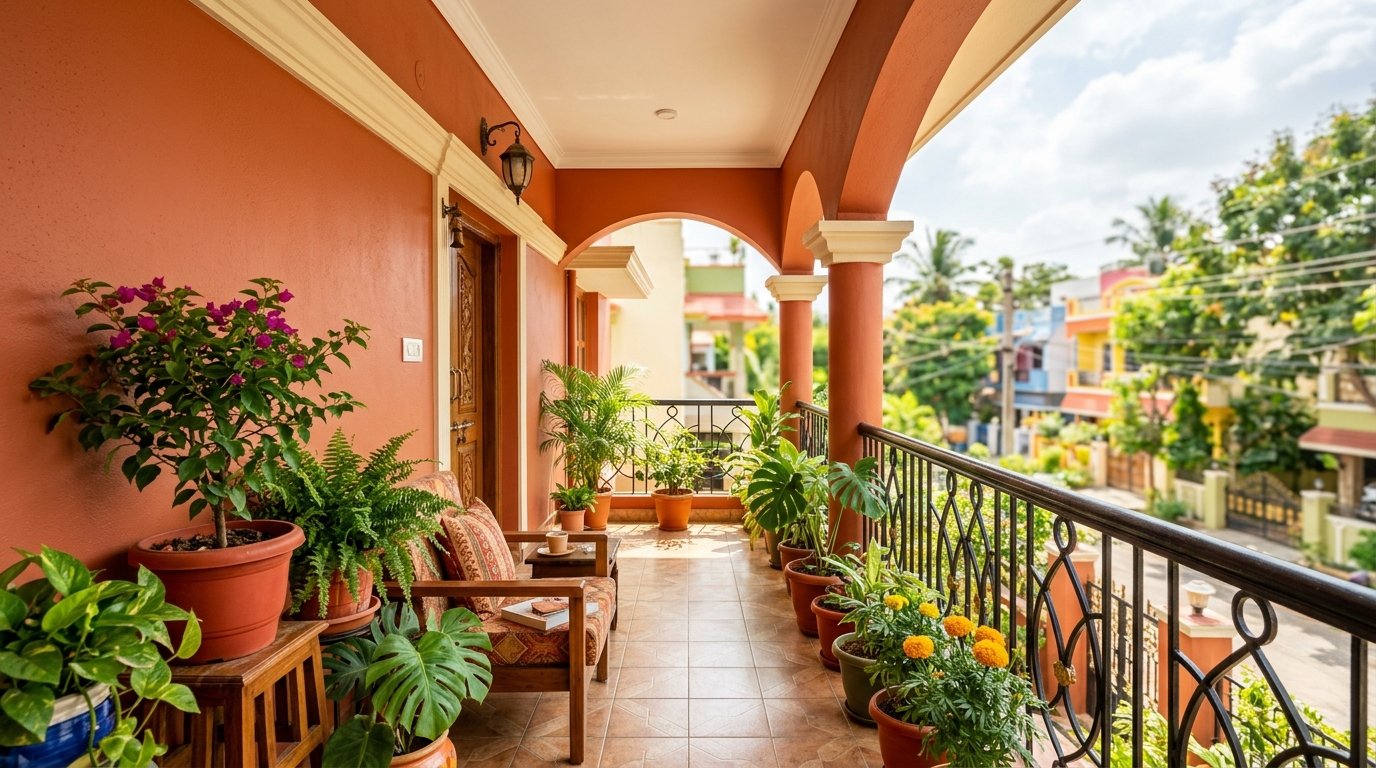
The balcony is the one space in an Indian home that is simultaneously loved and neglected. Families use it daily — for morning tea, evening conversations, drying clothes, tending plants — yet the paint on its walls is typically the last to receive attention and the first to deteriorate beyond recovery. Within twelve months of a standard paint job, a balcony wall in most Indian cities shows peeling edges, chalky fading, dark mould patches, and rust stains tracking down from the railing brackets. The floor cracks, the ceiling blisters, and what was once a pleasant outdoor extension of the home becomes a surface that is actively avoided or hidden behind plants and furniture.
This deterioration is not inevitable. It is the direct result of using interior-grade or general-purpose paints on a surface exposed to some of the most demanding environmental conditions any coating faces: full UV radiation, monsoon rain, tropical humidity, thermal cycling between cold nights and scorching afternoons, and biological growth from moisture and organic dust. A balcony painted with the right exterior-grade specification, prepared correctly, and maintained with basic annual attention will hold its finish and protective function for five to eight years — transforming one of the most visible parts of your home from an eyesore into an asset.
This guide covers every dimension of balcony painting: why standard paints fail, what the correct coating systems are for walls, ceilings, floors, and railings, how to prepare each surface, how to choose colours that age gracefully in the Indian climate, and how to plan the project safely and efficiently.
Why Ordinary Paints Fail on Balconies
Understanding the failure mechanism of a standard interior emulsion on a balcony wall reveals precisely why the right specification matters so much. Interior wall paints are designed for controlled, dry indoor environments. Their binder systems provide a film that breathes and flexes gently, but they are not formulated to resist the mechanical and chemical stresses that an outdoor surface faces continuously.
The first and most aggressive force is ultraviolet radiation. Direct sunlight in India — particularly in states such as Gujarat, Rajasthan, Maharashtra, and Tamil Nadu — delivers UV intensity that degrades the pigment and binder of ordinary paint rapidly. Within a season, chalking begins: a fine powdery deposit on the surface representing the degraded binder releasing its grip on the pigment. The colour fades, the surface weakens, and the protection against moisture entry drops to near zero. Interior emulsions, which contain no UV-blocking chemistry, chalk and fade within months on a south- or west-facing balcony.
The second force is moisture cycling. During the monsoon, a balcony wall absorbs water through any micro-crack or pore in the paint film. During dry periods, this moisture tries to escape as vapour, pushing outward through the paint film. If the paint film is not sufficiently breathable or flexible, this outward vapour pressure causes blistering. When blisters burst, they leave loose flaps of paint that eventually peel, exposing bare plaster or concrete to the next rain cycle. Over several seasons, this process leaves nothing of the original paint film intact.
The third factor is biological growth. The combination of moisture, warmth, organic dust from plants and the urban environment, and the nitrogen in air pollution creates ideal conditions for algae, mildew, and mould to colonise a damp balcony wall surface. These organisms do not merely stain the paint — they penetrate beneath it, using the paint film as a substrate. Their root-like structures physically separate the paint from the plaster, accelerating delamination. In many Indian balconies, the black-green staining visible on walls is algae that has been growing for multiple seasons, embedded well below the surface layer.
Choosing the Right Coatings: Walls, Ceilings, and Floors
Balcony walls require a dedicated exterior-grade emulsion — not a standard interior emulsion, and not a general-purpose paint that claims dual use. A quality exterior emulsion is specifically formulated with UV-resistant pigments, a weatherproof binder that remains flexible through temperature cycling, and anti-algal and anti-fungal additives that prevent biological colonisation. These products apply similarly to interior emulsions but their performance in outdoor conditions is in a completely different category. Look for products described as elastomeric or flexible exterior emulsion — these contain additional elasticity in their binder that allows the film to stretch and recover as the underlying plaster expands and contracts with temperature changes, preventing the micro-cracking that allows moisture entry.
For balcony walls with a history of water seepage — damp patches appearing from behind the wall, or the inner face showing moisture even after rain has stopped — a waterproof masonry coating or an elastomeric waterproofing paint must be specified rather than a standard exterior emulsion. These products create a thick, crack-bridging film over hairline cracks in the masonry and form a positive barrier against water penetration. Applied in two coats over a properly prepared surface, they eliminate the ingress cycle that causes persistent damp problems on balcony walls.
Balcony ceilings — the soffit of the floor above, which forms the ceiling of an open or semi-open balcony — are among the most problematic surfaces to finish durably. They receive indirect rain splash, high humidity, and condensation, but limited direct sunlight to drive off moisture. This creates a persistently damp micro-environment that is ideal for mould growth and adhesion failure. A moisture-resistant exterior ceiling emulsion with anti-fungal chemistry is the correct specification. If the ceiling has a history of staining from water seepage, a stain-blocking alkali-resistant primer must be applied first, otherwise pigment from the stain will bleed through any number of topcoats applied over it.
Balcony floors are a separate discipline from wall coatings. Most balcony floors in Indian apartments are finished in ceramic tile or stone, which need cleaning and grout sealing rather than painting. However, bare concrete balcony floors — common in independent houses and older apartments — deteriorate quickly without a protective coating. A two-component epoxy floor coating or a UV-stable polyurethane floor sealer is the appropriate specification for a balcony floor that must withstand foot traffic, plant pot scraping, water from rain and plant watering, and direct sunlight. A standard acrylic floor paint will fade and chalk within one season on a sun-exposed balcony floor; only a chemically cured, UV-stable system will hold.
Protecting Balcony Railings and Metal Elements
The railing is typically the first element on a balcony to show serious deterioration, and it is also the element that causes secondary damage to everything around it. Rust from an unprotected railing runs down the wall surface in dark orange streaks, stains the floor, and creates a stubborn contamination that makes repainting those areas far more difficult. Getting the railing right protects the entire balcony finish around it.
The correct system for iron or mild steel railings starts with thorough rust removal. All existing rust must be mechanically removed — wire brushed, ground, or sanded — down to bright, clean metal before any primer is applied. Any rust left under the primer will continue to spread beneath the new coating, and the new finish will fail at those points within months. For heavily rusted railings, a rust converter applied after wire brushing chemically transforms residual rust into a stable iron phosphate compound that does not continue to corrode and provides a better primer key.
Over the cleaned metal, apply a zinc-rich or anti-corrosive metal primer in two coats. Zinc-rich primers provide sacrificial protection — the zinc in the film corrodes preferentially to the underlying steel, slowing rusting significantly even if the topcoat is damaged. This is the standard for engineering applications and the correct specification for any metal surface in a coastal or high-humidity Indian environment. Over the primer, a high-quality enamel or polyurethane topcoat in the chosen colour provides UV stability, gloss retention, and a hard, washable surface finish. In coastal cities — Mumbai, Chennai, Kochi, Visakhapatnam — where salt-laden air dramatically accelerates metal corrosion, a two-pack polyurethane topcoat is the recommended specification for all metal railing systems.
Surface Preparation: The Step That Decides the Outcome
No exterior coating system performs well over an inadequately prepared surface. The sequence for preparing a balcony for repainting is demanding but not complicated: it simply requires doing each step properly before moving to the next.
Begin with a pressure wash or thorough scrub wash of all wall, ceiling, and floor surfaces. This removes loose paint, surface algae, dust, and any efflorescence — the white crystalline salt deposits that appear on masonry surfaces where moisture has migrated through the wall and evaporated. Efflorescence is purely mechanical and dissolves in water; it must be removed completely before painting, because any residue prevents adhesion. For surfaces with established algal or mould growth, apply a proprietary biocidal wash, allow it to dwell for the specified contact time, and rinse thoroughly. This kills the organisms and significantly reduces the risk of regrowth under the new coating.
Once cleaned and dry, repair all cracks in the masonry. Hairline cracks up to about one millimetre width can be bridged by an elastomeric exterior emulsion, but deeper or wider cracks must be filled with a cement-based exterior filler or a polyurethane sealant before painting. Cracks that are not filled allow water entry that will undermine even the best topcoat system within one rainy season.
Apply an exterior alkali-resistant primer over all prepared wall surfaces before the topcoat. Fresh or repaired plaster is highly alkaline, and this alkalinity can attack the binder of a topcoat applied directly over it — a process called saponification — causing adhesion loss and a soft surface. The primer neutralises this alkalinity and provides a uniform absorbency that ensures the topcoat applies evenly with consistent colour and sheen.
Colour Choices That Survive the Indian Climate
Colour selection for a balcony is not purely an aesthetic decision — certain colours age far more gracefully than others in Indian outdoor conditions, and making the wrong choice results in a surface that looks faded and degraded within two seasons rather than the five or more that the right specification should deliver.
The most important consideration is pigment stability under UV. Highly saturated, vivid colours — particularly bright blues, vivid greens, and strong reds — typically use pigments that are more susceptible to UV degradation than the pigments used in earthy, muted tones. A vivid cobalt blue balcony wall in direct western sun will fade noticeably within one summer; the same wall painted in a muted terracotta or warm clay tone will hold its colour for years. If bold colours are desired, consider using them on a single feature wall or on a sheltered balcony element, with a more stable muted tone on the sun-exposed faces.
Warm tones — terracottas, warm creams, ochres, dusty pinks, and muted sage greens — are historically proven performers in the Indian outdoor context, and there is a reason the traditional colours of Indian residential architecture fall in these families. They complement the warm quality of Indian daylight, age gracefully rather than fading to an unrecognisable wash, and their slightly earthen character reads as intentional even when some degree of weathering has occurred.
For balconies visible from the street or shared with a building's communal aesthetic, a lighter tone for the main wall with a deeper, more characterful colour on the soffit or railing provides a composed, considered palette that photographs beautifully and ages well. Avoid pure white on sun-exposed external masonry — it is the fastest colour to show algal staining, UV chalking, and water tracks, and the maintenance burden to keep it looking fresh is disproportionately high.
Maintenance: Keeping the Finish for the Long Term
A correctly specified and applied balcony coating system requires minimal but consistent maintenance to achieve its design life. Once a year — ideally just before the monsoon — inspect the entire balcony surface. Look for any areas where the paint is beginning to crack, check the railing fixings for rust bleed, clear any blocked drainage outlets that could cause water to pond on the floor or against the wall base, and trim back any plants in direct contact with the painted wall surfaces. Plants pressing against a painted wall trap moisture and create a microclimate that accelerates biological growth and paint degradation at that contact point.
If algal growth begins to appear — typically visible as a green-grey haze on the lower sections of north-facing walls — address it promptly with a diluted biocidal wash rather than leaving it to establish. A colony of algae removed at the surface haze stage takes fifteen minutes to treat; the same colony left for two seasons requires complete paint removal and retreatment before repainting. Post-monsoon cleaning of the balcony wall surfaces removes the organic debris deposited by rain and wind, reducing the nutrient load that feeds biological growth in the following season.
Touch up any chips or cracks in the paint film as soon as they are noticed. A small brush application of the same topcoat, feathered into the surrounding surface, prevents water entry at that point and extends the life of the overall coating system. Keep a small quantity of the original topcoat in a sealed tin specifically for this purpose — colour-matched touch-up is only possible with the original paint.
The Zorvanta Approach to Balcony and Outdoor Coatings
At Zorvanta, we formulate our exterior coating range specifically for the demands of Indian outdoor environments — the UV intensity, the monsoon moisture load, the alkaline masonry chemistry, and the biological growth conditions that make standard paints fail so quickly on balconies and outdoor surfaces. Our exterior elastomeric emulsion is our recommended specification for balcony walls: UV-stable pigments, a flexible binder that bridges hairline cracks, and integrated anti-algal chemistry that actively inhibits biological colonisation. Applied in two coats over our alkali-resistant exterior primer on a correctly prepared surface, it delivers a finish that remains protective and visually clean through multiple monsoon seasons.
For balcony floors, our UV-stable polyurethane floor sealer provides a clear, protective finish over concrete that resists foot traffic, water, and sunlight. For railings and metal elements, our zinc-rich anti-corrosive primer system followed by our PU enamel topcoat is the benchmark specification for coastal and humid-climate applications across India.
Whether you are repainting a compact apartment balcony that has seen four monsoons without treatment, or specifying a comprehensive coating system for a large villa terrace with multiple metal elements and a bare concrete floor, the investment in the correct specification — exterior-grade, properly primed, well prepared — returns its cost in the years of service life it delivers. Explore our exterior coating range, read our guide on terrace waterproofing, or contact our team for a surface-specific coating recommendation and project quotation.
Frequently Asked Questions (FAQs)
1. Can I use interior wall paint on my balcony walls?
No. Interior emulsions are not formulated for UV exposure, direct rain, or the sustained high humidity of an outdoor environment. They will chalk, fade, and peel within one to two seasons on a balcony wall. Always use a dedicated exterior-grade emulsion with UV-stable pigments and weatherproofing additives for any balcony or outdoor surface.
2. How do I remove the black-green stains from my balcony walls before repainting?
These stains are algae or mould established on the wall surface. Scrub the affected areas with a stiff brush and a proprietary biocidal masonry cleaner — available from paint suppliers — following the product instructions for dilution and contact time. Rinse thoroughly with water and allow the surface to dry completely before priming. Do not paint over algae or mould; the organisms survive beneath the paint film and regrow, causing the new finish to fail at those points.
3. How often should balcony walls in India be repainted?
A balcony wall painted with a quality exterior elastomeric emulsion over proper preparation should remain in serviceable condition for five to eight years, depending on orientation and climate. South- and west-facing walls in high-UV locations will need repainting closer to the five-year mark; sheltered or north-facing walls may reach eight years. Standard exterior emulsions without elastomeric chemistry typically last three to four years. Interior emulsions on balconies may need annual repainting.
4. What is the best way to prevent rust from the balcony railing damaging the wall paint?
The most effective approach is a full railing refurbishment: mechanically remove all rust, apply a zinc-rich anti-corrosive primer in two coats, then finish with a polyurethane or alkyd enamel topcoat. Where the railing bracket meets the wall, seal the junction with a flexible polyurethane sealant to prevent water tracking down into the wall. A railing maintained with this system will not produce rust runoff for eight to ten years, protecting the wall surface completely.
5. Should I waterproof my balcony walls or just paint them?
If your balcony wall shows signs of water seepage — damp patches, staining on the inner face, or salt efflorescence on the outer face — it needs a waterproofing treatment before painting, not just a fresh coat of exterior emulsion. Apply a penetrating silane-siloxane waterproofer or an elastomeric waterproofing coating as the base layer, allow it to cure fully, and then apply the exterior emulsion topcoat. If there is no active seepage and the wall is sound, a good-quality elastomeric exterior emulsion provides sufficient weather protection without a separate waterproofing layer.
6. What colours work best for balconies in Indian apartment buildings?
Warm, muted tones in the terracotta, warm cream, ochre, and soft sage families age most gracefully in the Indian outdoor context and complement the quality of Indian daylight. Avoid highly saturated or vivid colours on sun-exposed faces, as these fade unevenly and lose their appeal quickly. If the building has a shared colour palette, work within that palette for the main faces and use a complementary accent colour on a sheltered soffit or feature element. Pure white on an outdoor masonry wall requires very frequent cleaning and touch-up to remain presentable in Indian conditions.
Need help choosing the right finish?
Talk to our team or request a tailored quotation for your project.