Terrace Waterproofing: The Complete Guide to Protecting Roof Slabs in Indian Homes
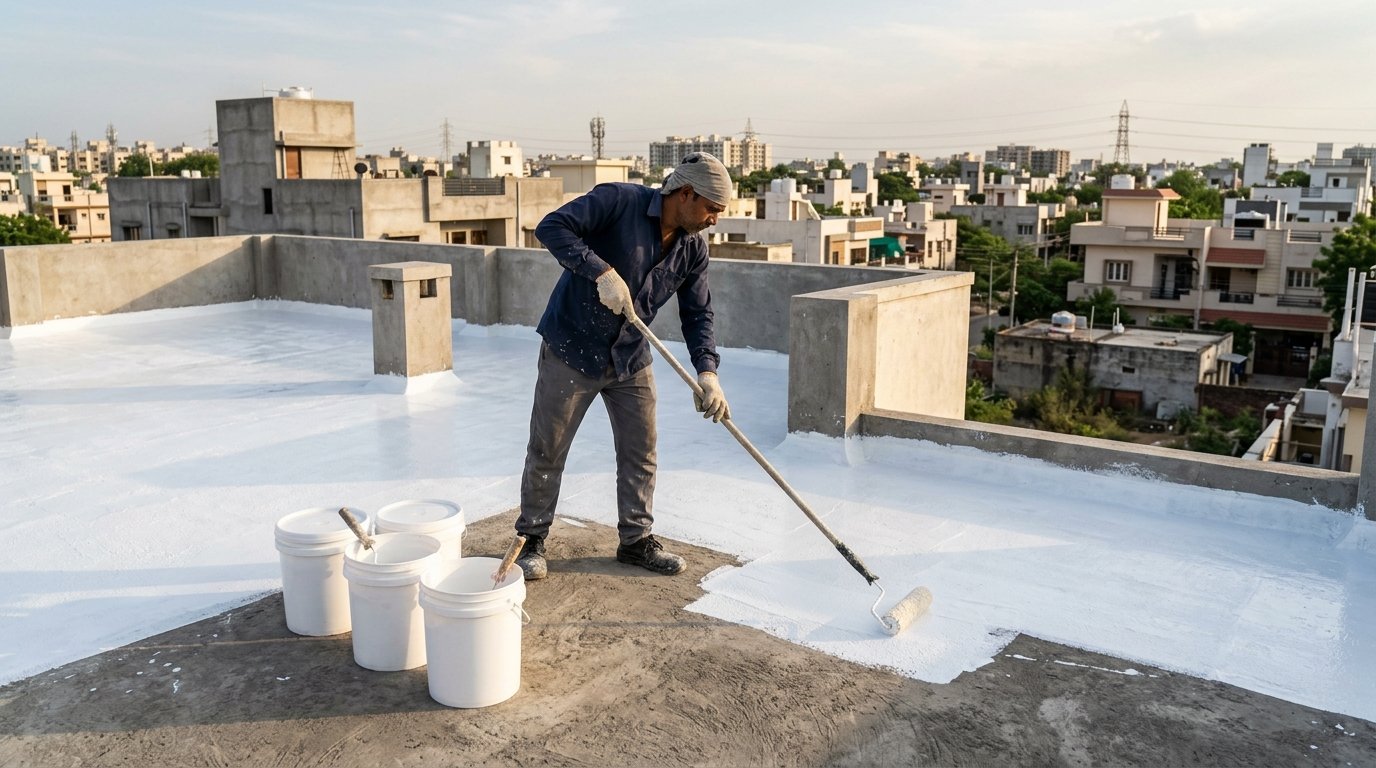
Of all the problems that plague Indian buildings, a leaking terrace is among the most destructive and the hardest to ignore. A hairline crack in a flat roof slab, invisible from above, becomes visible inside the building within one monsoon season — as a spreading damp patch on the ceiling, then as paint peeling in soft, sagging sheets, then as the first rust stain tracking down the wall where water has found the reinforcement steel beneath the plaster. Left unaddressed, terrace leakage is not just a cosmetic issue. It is a structural threat.
India's building stock is dominated by flat concrete slab roofs — the standard construction method for homes, apartments, and commercial buildings across the country. This geometry is practical and well suited to our climate, but it creates a specific vulnerability: rainwater cannot drain away by gravity as efficiently as on a sloped roof, ponding and thermal cycling put the concrete surface through repeated stress cycles, and the consequences of any waterproofing failure go directly into the living space below. Getting terrace waterproofing right is therefore not an optional upgrade. It is a fundamental maintenance requirement for any flat-roofed building in India.
This guide covers the full picture: why terrace slabs develop leaks, the main waterproofing systems used in India and their respective strengths and limitations, the surface preparation that makes or breaks any waterproofing application, and a practical step-by-step process for selecting and applying the right system for your specific terrace condition.
Why Flat Concrete Terraces Leak: The Root Causes
Understanding why a terrace leaks is the starting point for choosing the right fix. Most terrace leaks in Indian buildings come from one or more of four sources, and the correct waterproofing approach depends on which is at play.
Concrete shrinkage cracks are the most common cause of terrace leakage in newer buildings. Concrete shrinks as it cures and as it dries out through seasonal changes. On a large flat slab exposed to the sun, thermal expansion and contraction add further stress, and the cumulative effect over a few monsoon cycles is a network of fine cracks — often invisible to the naked eye — through which water can find its way. These cracks tend to concentrate at construction joints, at penetrations through the slab (pipes, columns, parapet junctions), and at any point where the concrete section changes thickness.
Failed or absent waterproofing on older buildings accounts for the majority of leakage problems in buildings more than ten to fifteen years old. The original waterproofing — brick bat coba, lime terrace, or an early-generation membrane — has reached the end of its service life. The material has cracked, separated, or degraded under UV, heat, and repeated wetting and drying cycles, and water is now moving through freely. This is a replacement task, not a patch repair.
Poor drainage design allows water to pond on the terrace surface. A flat terrace with inadequate slope toward the drains or with blocked drain outlets accumulates standing water after each rainfall. Standing water finds any crack, joint, or porous area in the concrete surface and works its way through gradually. Even a properly waterproofed surface under constant water pressure will eventually develop pathways if drainage is not maintained.
Parapet and junction failures are the point at which most membrane waterproofing systems fail. The junction between the horizontal terrace surface and the vertical parapet wall — and the flashing detail at the top of the parapet — is subject to differential movement as the wall and slab expand and contract at different rates. This movement tears or debonds membranes at the junction unless the detail has been specifically designed and installed to accommodate it. Water entering at parapet junctions tracks down behind the finish plaster and appears inside the building well away from the actual entry point, making diagnosis and repair more complex.
Waterproofing Systems for Indian Terraces: A Practical Comparison
The Indian market offers several fundamentally different terrace waterproofing systems, ranging from traditional methods used for decades to modern coating and membrane technologies. Each has specific strengths, limitations, and cost implications. Choosing the right system requires matching the system to the actual condition of the terrace, the severity of the problem, and the budget available.
Brick bat coba is the traditional Indian terrace treatment — a layer of broken brick pieces embedded in lime mortar, finished with a cement plaster screed, which provides both waterproofing and thermal insulation through its mass. Properly done, brick bat coba is durable and effective. The problems arise from poor execution: uneven laying, inadequate slope to drains, poor finishing of the cement screed, and failure to maintain the expansion joints. A failed brick bat coba that has cracked and allowed water ingress cannot simply be patched. It typically needs to be broken up and replaced, which is expensive and disruptive. However, where a terrace is being completely redone and thermal insulation is a priority, a well-executed brick bat coba with a properly specified cement finish and an additional coating layer remains a practical choice.
Bituminous (torch-on) membrane is the professional standard for new construction and major terrace refurbishment. A modified bitumen sheet — reinforced with fibreglass or polyester mat — is bonded to the prepared concrete surface using a bitumen primer and heat-applied using a propane torch to fuse the membrane to the substrate and seal the overlaps. A properly installed torch-on membrane, with correct detail treatment at junctions and penetrations, provides excellent waterproofing performance and a service life of fifteen to twenty years under Indian conditions.
The limitation of torch-on membranes is the installation complexity and fire risk during application. The torch application requires trained operatives and is not a DIY option. The membrane itself must be protected from UV degradation and foot traffic by a protective screed or ballast layer over the top. Used correctly, however, this is the most robust terrace waterproofing solution available for a slab in poor condition or for new construction.
Liquid-applied waterproofing membranes — acrylic, polyurethane, or polyurea-based systems applied as a liquid that cures to a seamless, flexible film — have become the dominant choice for terrace refurbishment and re-waterproofing in India over the past decade. Applied by roller, brush, or spray in two or more coats, these systems form a continuous, joint-free membrane over the terrace surface that accommodates thermal movement through the elasticity of the cured film.
Acrylic-based waterproofing coatings are the most widely used in the residential segment. They are water-based, easy to apply without specialist equipment, available in white or light colours that reflect solar radiation and reduce heat gain, and offer good adhesion to concrete and existing screed surfaces. A quality acrylic waterproofing system applied in the correct number of coats at the specified thickness will give five to eight years of effective performance on a well-prepared terrace.
Polyurethane liquid membranes offer higher elasticity, tensile strength, and UV resistance than acrylic systems, making them the specification of choice for terraces with significant movement at cracks or junctions, for commercial terraces with heavy foot traffic, or for any application where maximum durability is the priority. They cost more than acrylics but deliver substantially better long-term performance on demanding terraces.
Crystalline waterproofing treatments — penetrating products that react with the calcium hydroxide in concrete to form insoluble crystals that block the capillary pores — are a specialist option for concrete slabs where the concrete itself is sound but porous. These treatments are applied as a slurry to the surface, penetrate into the concrete, and provide waterproofing from within rather than as a surface coating. They are not a complete solution for cracked slabs or failed existing waterproofing, but on a structurally sound slab with residual porosity as the main leak pathway, they are a highly effective and permanent treatment.
Surface Preparation: The Step That Decides Everything
The most important factor in the success of any terrace waterproofing application is not the product — it is the surface preparation. Every manufacturer of waterproofing systems will state clearly that adhesion failure caused by inadequate surface preparation is the leading cause of early waterproofing failure. This is not a disclaimer. It is an accurate description of what happens in the field when preparation is rushed or skipped.
The preparation sequence for a terrace refurbishment begins with a complete survey of the existing surface. Identify all areas of cracking, delaminated screed, hollow areas, ponding zones, blocked drains, and failed junction details. Tap across the surface systematically — a hollow sound under foot or with a hammer indicates that the screed or existing waterproofing layer has separated from the slab beneath and must be removed. Painting over a delaminated screed traps the debonded material in place for another season before the new coating follows the same failure path.
Remove all loose, cracked, or delaminated material back to a sound substrate. This may mean breaking up sections of existing screed or brick bat coba. The extent of removal is determined by the actual condition of the substrate, not by what is convenient. Once the sound substrate is exposed, clean it thoroughly — remove all dust, dirt, biological growth (algae, moss), oil contamination, and loose particles. High-pressure washing followed by antifungal treatment and a drying period is the correct preparation sequence for most terraces.
Repair all cracks before applying any waterproofing system. Hairline cracks should be widened slightly with a grinder or cold chisel to create a V-groove that the repair mortar can key into, then filled with a polymer-modified repair mortar or a flexible polyurethane sealant. Wide cracks — anything above three millimetres — require a more robust repair, potentially including a reinforcing fabric bandage embedded in the repair compound to bridge the crack and resist future movement. Penetrations through the slab — pipe outlets, drainage points, column locations — must be sealed with appropriate flashing and sealant details before the main coating application begins.
The Correct Application Sequence for Liquid Waterproofing
With the surface properly prepared and repaired, the application of a liquid waterproofing system follows a specific sequence. Rushing any stage or reducing the number of coats to save time or material is the single most common cause of premature waterproofing failure in the Indian residential market.
Begin with a primer coat. Most liquid waterproofing systems specify a primer — typically a diluted version of the main coating or a dedicated bonding primer — that penetrates the prepared surface, seals the substrate porosity, and provides the adhesion interface for the build coats. On porous concrete or screed, skipping the primer allows the first coat of waterproofing to be absorbed unevenly into the substrate, producing a thin, inconsistent film with poor adhesion. Always apply the specified primer at the manufacturer's stated rate and allow it to dry fully before proceeding.
Apply the waterproofing coats in the correct number and sequence. Most acrylic terrace waterproofing systems specify a minimum of two to three coats, with the total dry film thickness of the completed system being the critical parameter — not the number of coats. Apply each coat at the correct spreading rate, working in consistent directions and overlapping each pass to eliminate holidays (thin areas or misses). Allow each coat to reach the correct tack-free or recoat stage before applying the next — applying a second coat over a wet first coat traps solvents and prevents the system from curing correctly.
At all junctions — parapet base, pipe penetrations, drain outlets, column locations — embed a reinforcing fabric (typically a fibreglass mesh or non-woven polyester fabric) into the wet first coat, press it down firmly, and allow it to cure before applying the subsequent coats over the top. This fabric reinforcement bridges any movement at the junction and prevents the coating from tearing at the most vulnerable points in the system. Skipping the fabric reinforcement at junctions is the most common reason that a liquid waterproofing system fails within its first or second monsoon season.
Allow the completed system to cure fully before any foot traffic or protection screed application. Acrylic systems typically require a minimum of 24–48 hours at ambient temperature before light traffic; polyurethane systems may require longer depending on ambient humidity and temperature. Do not apply a protection screed before the waterproofing is fully cured — trapping a partially cured membrane under concrete is a certain path to early failure.
Drainage: The Maintenance Step That Protects Your Investment
A perfectly applied waterproofing system will fail prematurely if the terrace drains are blocked and water is allowed to stand on the surface for extended periods. Ponding water creates a hydrostatic head that pushes water through any imperfection in the coating, accelerates UV degradation of the coating surface, and promotes biological growth that chemically attacks the coating binder over time.
After every waterproofing application, verify that all drains are clear, that the terrace has adequate slope toward the drains (a minimum of 1 in 80 is the general guideline for flat roofs in India), and that no areas of the terrace are prone to ponding after rainfall. If ponding areas exist, they should be corrected with a screed layer to improve drainage before the waterproofing is applied — a waterproofing coating applied over a ponding zone is fighting a permanent structural problem with a surface treatment, and the outcome is predictable.
Inspect and clean terrace drains at least twice a year — before the monsoon season and after it. Leaves, debris, and dust accumulate in drain outlets and can block them completely within a single season. A blocked drain on a terrace can allow water to back up to parapet level and over the parapet within a single heavy rainfall event. No waterproofing system is designed to resist that level of water exposure.
The Zorvanta Approach to Terrace Waterproofing
At Zorvanta, our terrace and roof waterproofing range is formulated specifically for the demands of Indian flat roofs — the thermal cycling between 45°C summer highs and monsoon-cooled surfaces, the UV intensity of Indian summers, and the sustained hydrostatic pressure of the monsoon season. Our acrylic terrace waterproofing system delivers high elasticity, strong UV reflectance in white and light colours, and a proven adhesion system that bonds correctly to both fresh concrete and the old screed surfaces typical of terrace refurbishment work.
For commercial terraces, roof gardens, and terraces with significant crack movement, our polyurethane terrace membrane system provides the higher elasticity and tensile strength that demanding applications require, with fabric reinforcement at all junctions and penetrations as standard. Our technical team provides application-specific guidance — the correct preparation sequence, the required number of coats for the film thickness needed, and the junction details that protect the most vulnerable points in the system.
A terrace waterproofing investment is only as good as the preparation done before the first coat goes down and the quality of the application that follows. Explore our full waterproofing range, read our companion guides on repainting damp and stained walls and monsoon-proofing your home, or contact our team for a site-specific recommendation and request a quotation for your terrace project.
Frequently Asked Questions (FAQs)
1. How often should terrace waterproofing be redone?
A well-applied liquid acrylic waterproofing system on a properly prepared surface typically gives five to eight years of effective protection under Indian conditions before recoating is needed. High-quality polyurethane systems can last ten to twelve years. Torch-on bitumen membranes, properly installed with a protection screed, can last fifteen to twenty years. The actual service life depends heavily on surface preparation quality, application correctness, and maintenance of terrace drainage.
2. Can I apply terrace waterproofing myself, or do I need a professional?
Acrylic terrace waterproofing systems are genuinely DIY-accessible — they are water-based, apply with standard rollers and brushes, and do not require specialist equipment. The preparation work — removing failed material, repairing cracks, cleaning the surface — is the most demanding part, and the quality of that preparation determines the outcome. Polyurethane and torch-on bitumen systems are better left to professional applicators familiar with the specific systems and junction details required.
3. My terrace is leaking from the parapet area. How do I fix it?
Parapet junction leaks require specific detail treatment. The junction between the horizontal surface and the vertical parapet must be cleaned back to a sound substrate, the crack or gap at the junction sealed with a flexible polyurethane sealant, and a fabric-reinforced waterproofing detail applied that extends at least 150–200 mm up the vertical parapet face and at least 150 mm onto the horizontal terrace surface. The fabric reinforcement at this junction is essential — without it, the coating will crack at the junction within one or two thermal cycles.
4. What is the best time of year to waterproof a terrace in India?
The optimal window is the dry season — typically October to April in most of India. The surface must be dry before application, ambient temperatures should be between 10°C and 40°C for most systems, and the coating needs at least 24–48 hours of dry weather after application to cure before any rain exposure. Pre-monsoon application (March to May) is common, but leaves only a short curing window. Post-monsoon application (October to November) is generally the safer and more effective choice, as it follows the period of maximum moisture stress and allows a full dry season for the coating to cure and perform before the next monsoon.
5. My terrace already has brick bat coba. Do I need to remove it before applying a coating?
Not necessarily — it depends on the condition of the existing brick bat coba. If it is structurally sound (no hollow areas, no cracks that have allowed water ingress into the coba layer itself, no vegetation growth in joints), it can serve as a sound substrate for an overcoat of liquid waterproofing after thorough cleaning and crack repair. If sections are hollow, cracked through, or have allowed sustained water ingress, those sections must be broken up and replaced before coating. A complete condition survey before any application decision is essential.
6. How do I stop algae and moss growing on my terrace waterproofing?
Biological growth on terrace waterproofing is common on north-facing surfaces, in areas of persistent shade, or where drainage is poor and moisture remains on the surface for extended periods after rain. Before recoating, treat all biological growth with an antifungal wash, scrub and rinse, and allow to dry fully. Look for a waterproofing product that includes a biocide component in the formulation, which provides medium-term resistance to biological regrowth on the cured film. Improving terrace drainage to reduce the duration of wet conditions on the surface is the most effective long-term strategy for controlling biological growth.
Need help choosing the right finish?
Talk to our team or request a tailored quotation for your project.