Monsoon-Proof Your Home: The Complete Guide to Waterproofing Paints & Rain Protection in India
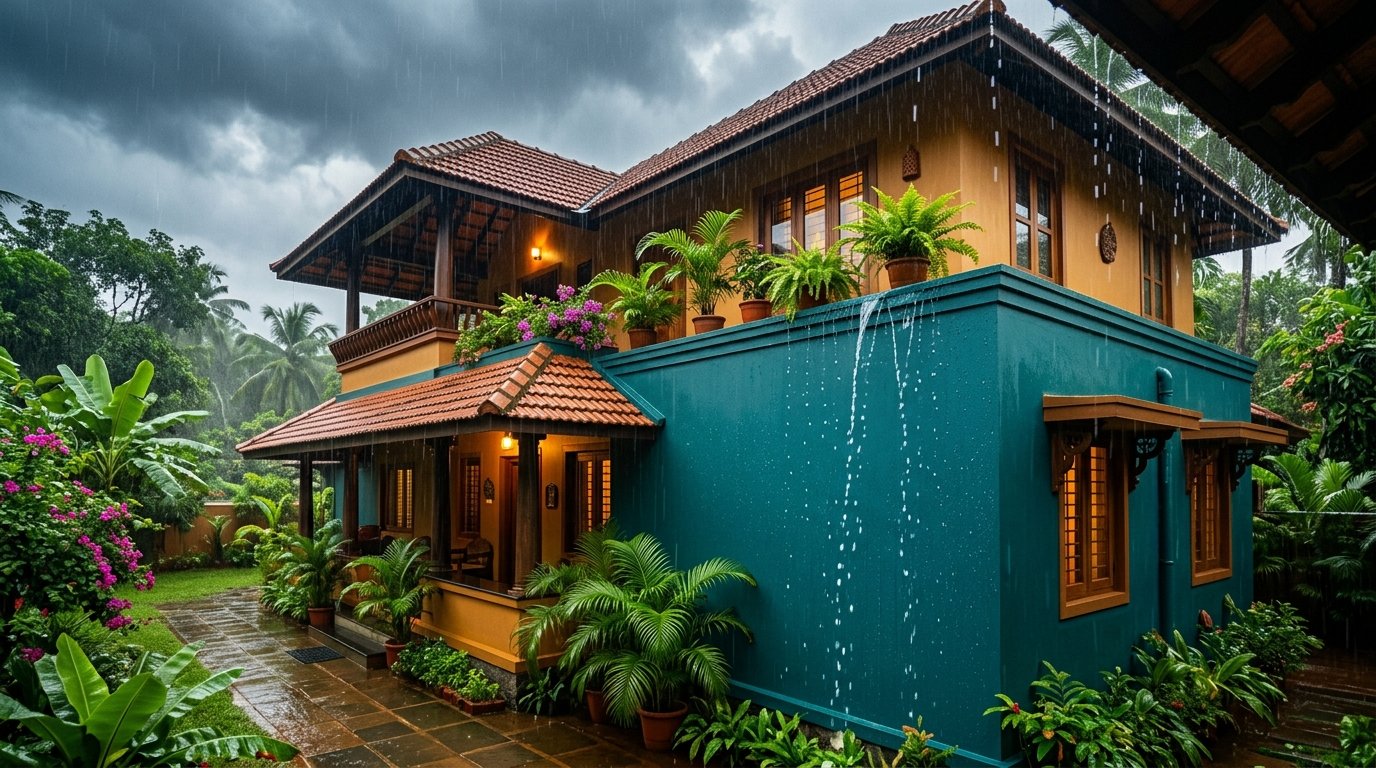
Every year, without fail, the monsoon arrives. Somewhere between the relief of the first rains and the third consecutive week of overcast skies and relentless showers, homeowners across India begin to notice the damage: a damp patch spreading across an internal wall, paint peeling off an exterior elevation that looked fine just months ago, a persistent musty odour in a room that never quite dries out. The monsoon does not suddenly ruin a building — it reveals the weaknesses that were always there, waiting for enough sustained moisture to make themselves visible.
The right response is not simply to repaint after the rains. By the time the visual damage appears, water has already entered the wall system, weakened plaster, encouraged fungal growth, and in some cases begun to corrode embedded reinforcement. The right response is to build a waterproofing strategy before the water arrives — one that addresses not just the surface appearance but the physics of how water moves through masonry and concrete.
This guide covers why Indian buildings are specifically vulnerable to monsoon water ingress, how different waterproofing coatings work, which systems suit which surfaces and situations, and the practical application steps that determine whether a waterproofing job holds up for five years or five months.
Why Indian Buildings Are Particularly Vulnerable
The challenge is not simply volume of rain — though India receives some of the world's highest annual rainfall in many regions — but the combination of factors that compound the problem. Most Indian exterior walls are built from brick or cement block plastered with cement mortar: a porous system that absorbs water readily and releases it slowly. Flat or low-slope rooftop terraces are common in residential construction, and they collect and hold standing water far longer than pitched roof designs. Expansion and contraction cycles driven by the extreme temperature swings between pre-monsoon heat and monsoon cooling open hairline cracks that are invisible in summer but become water channels by August.
The intensity and duration of Indian monsoon rainfall is unlike the intermittent showers typical of temperate climates. A single heavy monsoon shower can deliver more rainfall in two hours than many European cities receive in a month. That intensity creates hydrostatic pressure against walls and surfaces that ordinary exterior paints are simply not designed to resist. Conventional exterior emulsions provide a degree of water repellency — enough to manage light rain and drizzle — but under sustained driving rain and waterlogged ground conditions, water finds every weakness in the film and works its way through.
Understanding How Water Enters a Building
Effective waterproofing begins with understanding the specific pathways by which water enters. There are four primary mechanisms, and a robust waterproofing strategy addresses all of them.
Surface absorption. Masonry and plaster are inherently porous. Water driven against a wall under wind pressure saturates the outer face and is drawn inward by capillary action. This is the most common pathway in a direct rain-facing elevation and the one that surface-applied waterproofing coatings are most directly designed to address.
Crack infiltration. Hairline cracks in external render — even very fine ones, far below what the eye easily notices — become direct pathways when rain drives against them. A crack of less than a millimetre can admit water faster than a porous surface of several square metres. Waterproofing systems that cannot bridge these cracks will fail at exactly the points where protection is most needed.
Terrace and roof seepage. Flat terraces accumulate standing water, and any weakness in the terrace waterproofing — a failed joint, a crack in the screed, an inadequately sealed pipe or parapet junction — allows water to pond and slowly penetrate into the slab below. This produces the classic Indian monsoon problem of ceiling damp in the upper floor of a building even when the external walls appear unaffected.
Rising damp. Ground moisture wicks upward through masonry foundations and lower walls by capillary action, producing a characteristic horizontal damp band at skirting level that worsens through the wet season and recedes slowly in summer. This is a structural issue that surface coatings alone cannot fully resolve, though the right specification can manage the symptom significantly.
The Difference Between Waterproofing Coatings and Standard Exterior Paint
The term "waterproof paint" is used loosely in the market, and understanding the meaningful distinction between a genuine waterproofing system and a water-repellent exterior emulsion matters when specifying for monsoon conditions.
Standard exterior emulsion paints provide surface water repellency — they cause water to bead and run off a dry wall under normal rainfall conditions. They are not designed to resist sustained hydrostatic pressure, bridging active cracks, or preventing water penetration through a saturated wall. In light-to-moderate rain exposure, a quality exterior emulsion performs well. In sustained driving monsoon rain on a west or south-west facing elevation, it is insufficient as the sole water defence.
True waterproofing coatings work differently. Elastomeric waterproofing coatings — sometimes called flexible or crack-bridging waterproofing membranes — form a thick, rubber-like film on the surface that stretches with wall movement and spans hairline cracks without tearing. Applied at a sufficient film thickness, these coatings create a genuine water barrier rather than a surface repellent. They are the appropriate specification for elevations with any history of seepage, for monsoon-facing walls, and for terrace applications.
Cementitious waterproofing compounds are used as a wet application over terraces, water tanks, and basement walls. Mixed with water and applied in slurry form, they bond chemically to the cementitious substrate and produce a rigid waterproof layer. They do not accommodate movement and are not suited to surfaces that flex or crack, but on stable, well-prepared substrates they provide highly durable protection and form the standard specification for Indian terrace waterproofing.
Silicone and siloxane penetrating sealers work differently from surface film coatings — they penetrate into the pore structure of the masonry and line the pores with water-repellent chemistry without blocking vapour movement. The result is a wall that sheds surface water but still breathes. These sealers are valuable on ornamental stone, brick faces, and heritage surfaces where a visible coating film would be inappropriate, but they provide no crack-bridging capability and are not a substitute for a film-forming waterproofing membrane where active seepage is a concern.
Choosing the Right System for Each Surface
External rendered walls. The first choice is whether to use a high-build elastomeric waterproofing coat or a premium exterior emulsion with a waterproofing additive. For walls with no history of seepage and in less directly rain-exposed positions, a quality exterior emulsion remains adequate. For monsoon-facing elevations, walls with any previous cracking or damp history, or walls that have already failed and been repaired, an elastomeric waterproofing coat is the correct specification. Apply it over a properly prepared, crack-free surface after addressing all substrate defects — a waterproofing coat cannot fix a deteriorating substrate; it can only protect a sound one.
Terraces and flat roofs. Terrace waterproofing is a dedicated subject. The correct system depends on whether the terrace is accessible or inaccessible, whether it is laid to proper falls, and whether existing waterproofing is being maintained or replaced. For an accessible terrace in India, the standard approach is a cementitious waterproofing slurry applied in two or three coats over clean, dampened concrete, followed by a protective screed and tiles, or a finished surface that protects the waterproofing membrane from UV degradation and foot traffic. Junctions at parapets, outlet pipes, and any penetrations require special attention — these are the points where most terrace waterproofing systems ultimately fail, regardless of the quality of the field membrane.
Parapet walls and copings. The tops of parapet walls — horizontal surfaces that directly collect standing water and are exposed from both sides — are disproportionately responsible for water ingress into building facades below. A waterproofing membrane on the parapet top and a correctly sealed coping detail are as important as the field wall coating. This detail is frequently overlooked because it is not visible from the ground and is often assumed to be someone else's responsibility.
Interior walls affected by seepage. When water has already entered through the external wall and is manifesting on interior surfaces, the correct response is to address the source on the exterior, not to treat the internal wall surface. An interior dampproofing coat applied over an actively wet wall buys time at best. The water will continue to travel and will eventually find another exit point. Interior anti-damp coatings are appropriate after the external cause has been resolved and the wall has dried thoroughly — they prevent residual moisture marks from reappearing through fresh internal paint.
Surface Preparation: The Step That Determines Everything
Waterproofing products are only as good as the surfaces they are applied to. This principle is even more critical for waterproofing than for standard decorative coatings, because any gap in the preparation becomes a gap in the protection — and water is remarkably efficient at finding every gap.
Begin with a thorough inspection. Walk the full perimeter of the building after a rain shower and photograph every damp patch, every crack, every area of loose or hollow-sounding plaster. Record where water stains appear on internal walls and map them back to the most likely external entry point. This inspection is worth more than any product selection decision made without it.
Hack out all loose, hollow, and unsound plaster — it will never form a solid base for a waterproofing coat, and applying one over it merely delays the re-failure. Allow repaired areas to cure for at least 28 days before applying any waterproofing system; fresh cement mortar is alkaline and still curing, and applying a coating too soon can trap moisture in the repair and cause premature failure.
Fill all cracks with an appropriate repair material matched to the crack width and activity. Hairline cracks can be filled with a crack sealant; wider structural cracks need raking out, priming, and filling with a flexible repair compound before the waterproofing coat goes on. Do not simply apply the waterproofing membrane over an unfilled crack and expect the coating alone to hold — even elastomeric coatings have limits to the crack width they can bridge without being applied at sufficient film thickness.
Clean the surface of all biological growth, efflorescence, and contamination before applying any coating. Algae, moss, and fungal colonies must be treated with an appropriate biocidal wash and removed completely. Salt deposits from efflorescence must be brushed away after the wall has dried — painting over active efflorescence, even with a waterproofing coat, will result in the salts continuing to crystallise beneath the film and lifting it from the surface within one or two monsoon seasons.
Application Timing and Seasonal Considerations
Waterproofing is ideally applied before the monsoon arrives — typically in April and May in most of India, or in the post-monsoon dry period of October and November for corrections and maintenance. Applying waterproofing coatings during active monsoon conditions is genuinely difficult: surfaces may not be fully dry, application is impractical in rain, and drying and curing times are extended by high humidity. The cured film needs adequate time to develop its full waterproofing properties before being exposed to sustained water.
If repairs must be made during the monsoon — because a leak has become urgent — prioritise stopping the water entry at source with a fast-setting hydraulic cement or plug, allow the immediate repair to set, and plan the proper coating application for the first extended dry spell. A temporary fix during the rains followed by a proper specification when conditions allow is far better than attempting a full waterproofing application on a wet wall in high humidity.
Temperature matters. Most waterproofing coatings require surface temperatures above 10°C and below 40°C for correct film formation. On sun-facing walls in extreme pre-monsoon heat, surface temperatures well above air temperature are common — a wall facing west in May at 3 pm can reach 55°C or more. Apply in the early morning on these elevations, when the wall has cooled overnight and the day's heat has not yet built.
Maintenance Between Seasons
A waterproofing system is not a one-time fix. Like any protective coating, it ages under UV exposure, temperature cycling, and the mechanical stress of building movement. An annual inspection before the monsoon season — looking specifically for new cracks, lifting or blistering areas in the coating, and compromised junctions at windows, pipes, and parapets — allows problems to be addressed with a targeted touch-up rather than a complete reapplication.
Keep drainage channels, gutters, and downpipes clear before the rains. Water backing up over a parapet or pooling on a terrace because a drain is blocked can overwhelm even a correctly specified waterproofing system. Simple maintenance of drainage is as important as the quality of the coating.
Inspect the junctions between different materials — where painted masonry meets window frames, where terrace waterproofing meets parapet walls, where downpipes are fixed to the elevation. Sealants at these junctions degrade over time and may need renewal every three to five years. These details are small relative to the area of a building but disproportionately responsible for the majority of water ingress.
The Zorvanta Approach to Monsoon Protection
At Zorvanta, our Exterior Gold Pro range is formulated specifically for Indian monsoon conditions. The elastomeric exterior coating delivers genuine crack-bridging capability, tested UV resistance for the intensity of the Indian sun, and a water-repellent film that maintains its integrity through sustained rain exposure. For terrace and high-exposure applications, our waterproofing specialist range offers cementitious and polymer-modified systems designed to meet the specific challenges of flat-roof and parapet waterproofing in Indian construction.
We do not recommend a one-size approach to waterproofing because the right specification depends on the surface, the building's history, and the severity of the exposure. Our team is experienced in assessing buildings across the full range of Indian climates — from the intense monsoon of the Western Ghats and Kerala coast to the moderate rainfall of north India and the semi-arid conditions of Rajasthan — and in recommending systems that are correctly matched to what the building actually faces.
Explore our full exterior and waterproofing range, read our companion guides on exterior wall painting and heat protection, surface preparation before painting, and diagnosing and fixing paint failures. For an assessment specific to your building and a waterproofing recommendation matched to your situation, contact our team or request a quotation.
Frequently Asked Questions (FAQs)
1. What is the best waterproofing paint for exterior walls in India?
For monsoon-exposed exterior walls, an elastomeric waterproofing coat with crack-bridging capability is the most robust solution. It outperforms standard exterior emulsions in sustained rain exposure and provides a flexible membrane that accommodates hairline cracking without failing. The specific product should be matched to the substrate condition and the severity of rain exposure — your paint supplier can recommend the correct system after understanding your building's history.
2. Can I apply waterproofing paint during the monsoon?
It is strongly advisable to apply waterproofing coatings before the monsoon begins, ideally in April or May. Applying to a wet wall in high humidity significantly compromises adhesion, film formation, and long-term performance. If urgent repairs are needed mid-monsoon, use a fast-setting hydraulic cement to stop active water entry temporarily and plan the proper waterproofing application for the first sustained dry period.
3. How often should exterior waterproofing be redone?
A quality elastomeric waterproofing coat applied over a well-prepared surface should last five to eight years before requiring complete reapplication. An annual pre-monsoon inspection allows targeted touch-ups at cracks, junctions, and areas of wear, which extends the life of the full system significantly. Inadequate preparation, over-thinning of the coating, or insufficient film thickness can reduce effective life to two or three years.
4. Is a terrace waterproofing system the same as wall waterproofing?
No — they are different systems for different conditions. Terrace waterproofing must withstand standing water, UV exposure, foot traffic, and the thermal cycling of a flat surface exposed to direct sun. Cementitious waterproofing compounds with protective overlays are the standard specification for Indian terraces. Wall waterproofing deals primarily with driving rain rather than standing water, and elastomeric membranes or high-quality exterior coatings are more appropriate in that application.
5. Why does damp keep appearing in the same spot even after repainting?
Repainting over the symptom without addressing the source is the cause. Water is entering from somewhere — a crack in the external render, a failed terrace joint, a leaking downpipe junction, or a parapet detail — and the internal damp marks are just where it eventually emerges. Identify and seal the entry point on the exterior; the internal marks will then resolve once the wall dries, and a repaint of the internal surface will hold.
6. Should I use waterproofing additive in regular exterior paint?
Waterproofing additives mixed into standard exterior emulsions improve the water repellency of the finished coat but do not transform the product into a genuine waterproofing membrane. They are useful as a performance upgrade for walls in moderate exposure, or as part of a system where a liquid-applied waterproofing primer goes on first and the emulsion acts as the decorative finish. Where the wall has a history of seepage or is in a high-exposure position, a dedicated waterproofing coating is the correct specification rather than an additive in a decorative coat.
Need help choosing the right finish?
Talk to our team or request a tailored quotation for your project.