Painting a Child's Room: Non-Toxic Paints, Washable Finishes & the Right Colours for Indian Homes
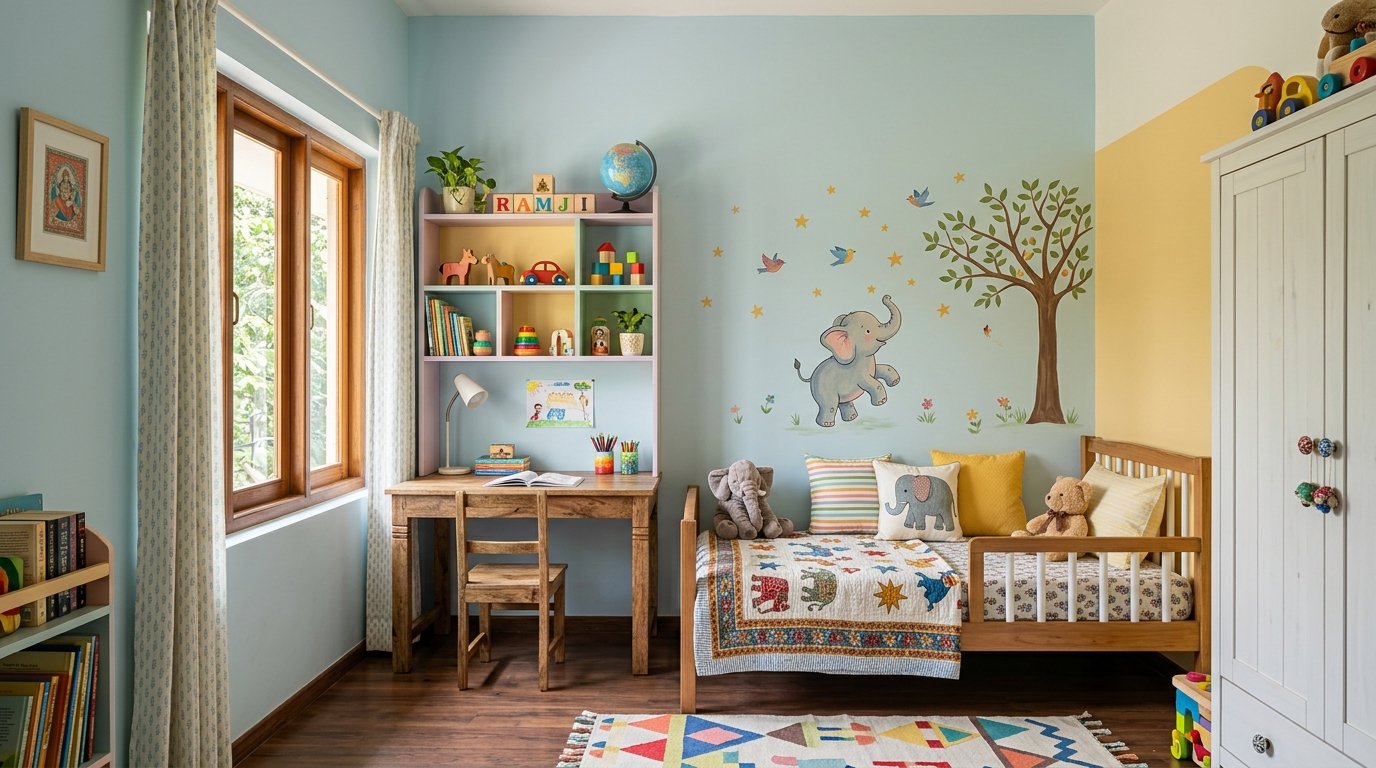
Of all the rooms in an Indian home, the one where paint specification matters most is arguably the room most people think about least carefully: the child's bedroom. Parents spend hours choosing furniture, bedding, and study fixtures, and then paint the walls with whatever was left over from the living room — a standard matte emulsion, possibly in a colour their child liked at a single glance in the hardware shop. The results are predictable: within a few months, the walls are scuffed at every reachable height, there are crayon lines along the dado zone, and the corner near the study table has a persistent smear of pencil and eraser residue that no amount of wiping can remove without damaging the paint surface.
Getting the paint specification right in a child's room is genuinely more important than in any other part of the house, for two distinct reasons. The first is health: children spend more hours per day in their bedroom than anywhere else — sleeping, studying, playing — and they are closer to the walls, more likely to touch them, and far more likely to put their hands near their faces immediately after contact. The off-gassing of volatile organic compounds (VOCs) from paint that continues for weeks after application is absorbed at a much higher effective dose by a child sleeping in a freshly painted room than by an adult spending a few hours in it. The second is function: a child's room wall takes a category of abuse that no other interior surface in the house receives — crayon, pencil, paint from art projects, food and drink impacts at seated height, and the continuous scuffing from toys, bags, and the child themselves. A standard matte emulsion does not survive this environment for more than a season before looking irredeemably worn.
This guide covers both dimensions: what to paint with, and how to choose colours that create an environment that is genuinely good for a child's development and daily wellbeing — not just a room that looks playful in a photograph.
Why VOCs and Paint Chemistry Matter in a Child's Room
Volatile organic compounds are the chemical solvents and reactive agents used in many conventional paints to carry the pigment and binder, improve flow, and accelerate drying. Once the paint is applied, these compounds evaporate into the room air — a process that continues long after the paint has dried to the touch. In a well-ventilated adult living space, this off-gassing dissipates quickly and presents minimal health concern at the concentrations generated by modern interior paints. In a child's bedroom that is often kept with windows closed at night, with the child present for eight to ten hours continuously, the exposure picture is meaningfully different.
Infants and young children have respiratory systems that are still developing, and their bodies process inhaled chemicals less efficiently than adults. They breathe faster relative to their body weight, increasing the dose of any airborne compound they receive per hour. The World Health Organisation and multiple national health bodies have identified VOC exposure from fresh interior paint as a source of indoor air quality concern that warrants caution, particularly in spaces occupied by young children.
The practical response to this is straightforward: choose a low-VOC or zero-VOC interior emulsion for children's bedrooms. These products use water as the primary carrier rather than solvent, with pigments and binders formulated to minimise the reactive chemical content. A genuine low-VOC emulsion — one independently certified rather than simply labelled as such — will off-gas minimally even in the first 48 hours after application. For a baby's room or a nursery being prepared before a newborn arrives, zero-VOC paint is the only specification that should be considered, and adequate ventilation for at least 72 hours after application should be maintained before the child occupies the room, regardless of the product used.
Beyond VOC content, check that any paint used in a child's room does not contain heavy-metal-based pigments. Older or cheaper paints may use lead-based or cadmium-based pigments for certain bright colours — particularly reds, oranges, and yellows. These are increasingly regulated or banned, but the informal paint market in India still carries products of uncertain provenance. Choose paints from established manufacturers with clear, certifiable ingredient disclosures. If your child has a habit of picking at paint chips on walls — as very young children often do — the specification of a safe, certified, zero-heavy-metal formulation is non-negotiable.
Washable Finishes: The Only Practical Choice for Children's Walls
The single most impactful specification decision for a child's room wall is the choice of finish sheen, and the answer is unambiguous: the wall must be washable. A matte emulsion applied to a child's bedroom wall will require full repainting within two to three years — or less — simply because it cannot be cleaned. Every crayon mark, every pencil scrawl, every food splash, and every toy impact that marks the surface can only be addressed by repainting. Given how frequently these impacts occur in a child's room, the cumulative cost and disruption of repeated repaints adds up quickly. A washable finish applied once and maintained correctly is the economically and practically superior choice over any time horizon longer than one year.
Eggshell finish is the entry-level washable specification for children's rooms. It dries to a very low sheen — almost matte in appearance, with just enough surface hardness to be wiped clean with a damp cloth for fresh marks. For a child's room where the priority is maintaining a near-matte, calm appearance while gaining basic cleanability, eggshell over a quality low-VOC emulsion is a reasonable starting specification for an older child's or teenager's room.
Satin finish is the preferred specification for children's rooms in most Indian homes, and particularly for the rooms of younger children and toddlers. Satin dries harder and denser than eggshell, has a gentle sheen that adds vitality to the colours used without making the room feel clinical, and is genuinely cleanable with a damp cloth and a mild household detergent — including most crayon and washable marker marks that have not been left too long. A quality satin emulsion applied to a properly prepared surface in a child's room will hold its appearance and cleanability for five to seven years even under the continuous contact and occasional impact that a child's room receives. This is a significant performance difference from a matte emulsion that shows wear within months.
Some manufacturers offer specific scrubbable or scrub-resistant emulsions — products formulated with harder film-building chemistry that allows scrubbing with a damp brush or sponge, rather than simply wiping. These are the correct specification for very high-contact zones in a younger child's room — particularly the wall sections between floor level and about 120 centimetres height, which is the zone receiving the highest density of contact, marks, and impact. Applying a scrubbable finish in this lower zone with a satin above it is a practical two-specification approach that provides maximum protection where it is most needed while keeping costs proportionate.
Colour Psychology for Children's Rooms: Getting Beyond the Obvious
The default colour choice for a child's room in India is frequently an extremely bright, saturated version of whatever colour the child expressed enthusiasm for — a vivid electric blue, a hot pink, a primary red — applied to all four walls, sometimes with a contrasting accent painted in an equally vivid tone. The reasoning is that children love bright colours and this will make them happy. The reality of colour psychology research suggests a more nuanced picture.
Very high-saturation, intense colours used on all walls of a small room can create a stimulating environment that is counterproductive for sleep and for sustained concentration during study. The same colours that feel exciting and playful for short periods can become fatiguing and overstimulating when a child is exposed to them for the extended periods that a bedroom demands — including the hours of sleep during which the visual environment before sleep onset affects the nervous system's ability to calm down. This is why children raised in intensely coloured bedrooms sometimes resist bedtime — the environment itself is working against the calming needed for sleep onset.
The approach supported by research on children's environments and supported by interior designers who specialise in children's spaces is to use softer, slightly muted versions of the child's preferred colours as the primary wall tone, reserving the more saturated versions as accents on a single feature wall or in smaller decorative elements such as furniture, soft furnishings, and artwork. A wall painted in a soft powder blue creates a calming background that still reads clearly as blue and satisfies a child's colour preference without creating an overstimulating visual environment. The accent of brighter blue can then appear in the bedding, a feature panel, or painted shelving without dominating the overall room environment.
For different age groups, different colour families work better. Nurseries and infant rooms benefit from very soft, warm tones — pale lemon, warm cream, soft sage green, or dusty rose — that create a calm, womb-like warmth without the stark whiteness that can feel cold and institutional. These colours also work beautifully under the warm LED or incandescent lighting typically used in nurseries. Toddler and young child rooms can handle slightly more colour energy — a soft sky blue or a warm coral on three walls with a more vivid accent wall is an effective balance. Older children and teenagers should ideally be involved in choosing their room colour, and a good approach is to present them with three or four options within a curated palette rather than open-ended choice — this keeps the result liveable while giving them genuine agency over their personal space.
Surface Preparation: Doing It Right Before the Child Moves In
The preparation standards for a child's room paint job are the same as for any quality interior repaint, with one additional priority: the surface must be completely dry, sound, and free from any flaking or loose material before the new paint is applied. Any surface defect — a patch of old paint lifting at an edge, a repaired crack that has not been properly feathered, a damp patch that has not been treated — is not merely an aesthetic issue in a child's room. Loose paint that can be picked off by a curious toddler, or a flaking area that produces paint fragments, is a safety concern. Address all surface defects completely and to a higher standard than you might in a room used only by adults.
Sand the walls lightly to remove any gloss from the existing surface and provide mechanical key for the new coat. Wipe down with a clean, damp cloth to remove all dust before painting. If the room has any previous paint that is cracked, flaking, or of unknown provenance — particularly in older homes or previously rented properties — consider stripping back to bare plaster and starting fresh with a certified low-VOC primer and topcoat system. This removes any uncertainty about what the child is living with on their walls.
Allow the painted room to ventilate fully after application. Keep windows open for a minimum of 48 to 72 hours after the final coat — even for low-VOC products — before the child returns to sleep in the room. In practice, scheduling a room repaint during a period when the child will be staying elsewhere for a few days gives the paint the aeration time it needs without disrupting the household routine.
The Zorvanta Approach to Children's Room Paints
At Zorvanta, we understand that a child's room is not just another interior surface — it is an environment that directly affects a child's health, sleep, and development day after day. Our Deco Gold Pro interior emulsion in satin finish is our recommended specification for children's bedroom walls: low-VOC formulation, excellent scrub resistance, genuine washability with a damp cloth, and a palette available in the soft, slightly muted tones that work best as primary wall colours for children's spaces. Our products carry clearly disclosed technical data sheets, and we do not use heavy-metal-based pigments in any of our interior wall ranges.
For parents who want the highest level of assurance on the safety question, our colour-mixing team can advise on the specific formulations in our range with the lowest VOC content and guide you through colour selection for different ages and room orientations. A north-facing child's bedroom in a Pune flat needs a different colour approach from a south-facing room in a Chennai house, and our team understands these nuances from practical experience across Indian conditions.
Whether you are preparing a nursery for a new arrival, repainting a toddler's room that has accumulated two years of crayon evidence on every accessible wall, or refreshing a teenager's room with a colour that actually reflects who they are at twelve rather than who they were at four, the investment in getting the specification right — safe, washable, correctly coloured — pays back in the reduced disruption of frequent repaints, in the cleaner and healthier environment your child sleeps and studies in, and in a room that remains genuinely pleasant for both the child and the rest of the household for years. Explore our interior paint range, read our guide on colour psychology in interior spaces, or contact our team for a personalised consultation and colour recommendation for your child's room.
Frequently Asked Questions (FAQs)
1. Is it safe to paint a baby's room just before the baby arrives?
Yes, provided you use a genuine zero-VOC or very low-VOC paint and allow at least 72 hours of full ventilation with windows open after the final coat before the baby occupies the room. The safer practice is to complete the painting four to six weeks before the due date, giving plenty of time for any residual off-gassing to dissipate completely. Avoid using solvent-based paints, oil-based enamels, or any paint with strong fumes in a nursery under any circumstances.
2. What is the best washable paint for children's bedroom walls in India?
A satin-finish, low-VOC interior emulsion from a reputable manufacturer is the recommended specification for most children's rooms. Satin provides genuine cleanability — crayon and washable marker marks can be wiped off with a damp cloth — while maintaining a residential appearance that is not overly clinical. For very young children or toddlers, look specifically for products described as 'scrubbable' or 'scrub-resistant' for the lower section of the wall up to about 120 cm height.
3. Can I use normal interior wall paint in a child's room?
Standard interior matte emulsions are not recommended for children's rooms on two counts: they are not washable, and standard formulations may have higher VOC content than the low-VOC or zero-VOC products now available. A dedicated children's room paint specification — low-VOC, satin or scrubbable finish — is meaningfully better on both safety and durability grounds and costs only marginally more than a standard emulsion.
4. What colours work best for a child's study area within the bedroom?
For the wall behind or around a study desk, colours in the green family — soft sage, muted olive, warm pistachio — are associated in research with sustained attention and reduced visual fatigue during reading and study. Avoid very bright or saturated colours behind the study area, as these compete visually with the study material and can increase distraction. A calmer tone in the study zone, with slightly more energetic colour in the play or sleeping area of the room, is a practical approach for a combined bedroom-study room.
5. How do I get crayon marks off a freshly painted satin wall?
Fresh crayon marks on a satin surface can usually be removed with a damp cloth and a small amount of mild dish soap. Rub gently in a circular motion and rinse with a clean damp cloth. For older or more deeply embedded crayon marks, a very small amount of white toothpaste applied with a damp cloth and rubbed gently is often effective. Avoid abrasive scouring pads or strong solvent-based cleaners, which will damage the paint surface even on a satin finish.
6. When should I repaint my child's room as they grow older?
A well-applied satin emulsion in a child's room should remain in serviceable condition for five to seven years before full repainting is needed. However, many families choose to repaint their child's room at key developmental transitions — when a toddler moves from a nursery to a 'big kid' room, when a primary school child moves to secondary school, or when a teenager wants a room that reflects their evolving identity. Repainting at these transitions is also a practical opportunity to upgrade the specification if the original paint was not fully washable or if the colours were chosen purely for the child's earlier age.
Need help choosing the right finish?
Talk to our team or request a tailored quotation for your project.