Painting Staircase Walls & Ceilings: The Complete Guide for Indian Homes
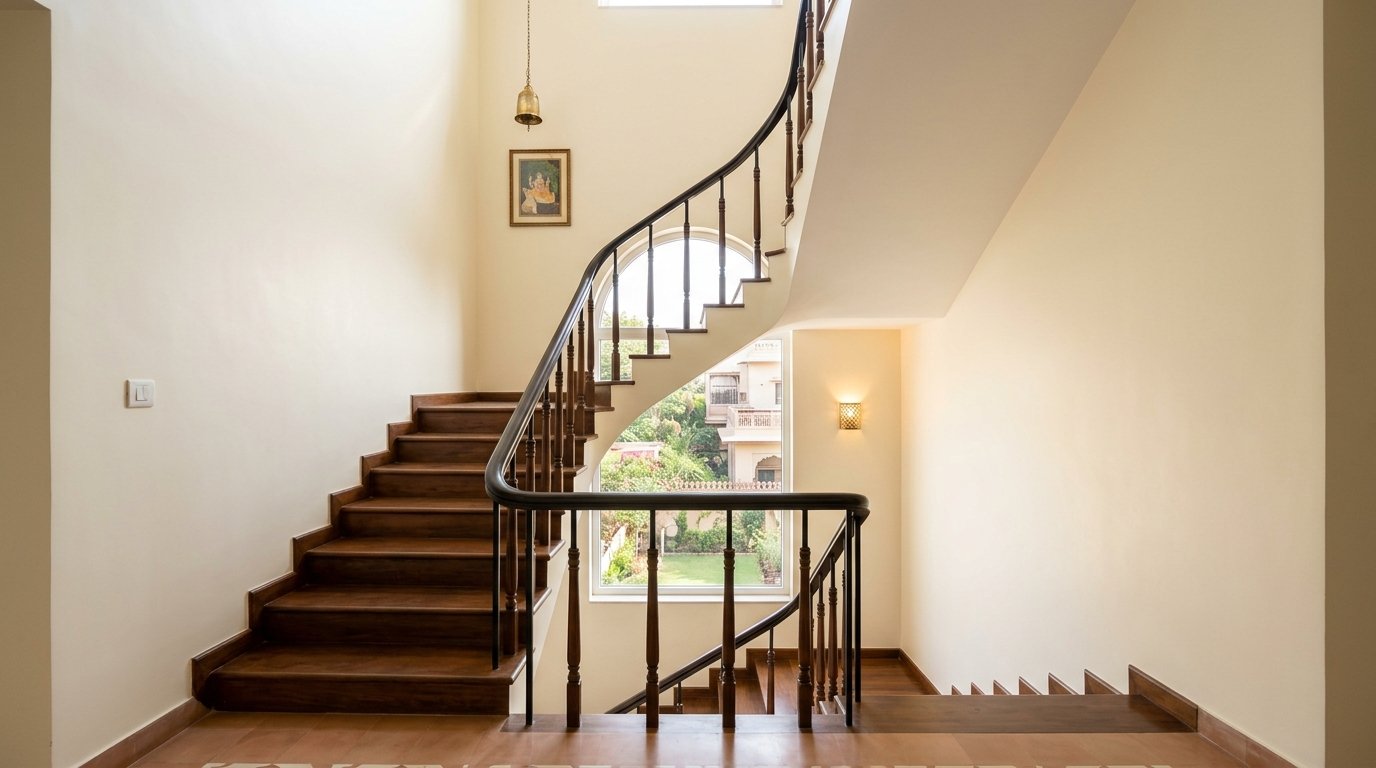
The staircase in an Indian home is one of the hardest-working surfaces in the entire building. Every person who climbs those stairs contributes to the gradual degradation of the adjacent walls — a shoulder brushing against the plaster, a bag swung carelessly around the landing turn, small hands trailing along the surface from ground floor to first floor. Add to this the double or even triple-height wall that runs beside a typical Indian staircase, and you have a painting project that is genuinely different in almost every way from a standard bedroom or living room repaint.
Despite this, staircase walls are routinely painted with the same specification as the rest of the house — the same standard emulsion applied with the same brush, the same colour, and the same preparation. The results are predictable: the staircase walls show wear first, fade fastest, and require touching up most frequently. Scuff marks appear within months, particularly at handrail height and at the turning points on each landing. The ceiling — typically very high and awkwardly positioned — collects dust and cobwebs and is difficult to reach for even basic cleaning, let alone repainting.
This guide addresses the staircase as the specific, demanding surface it is. We cover the right product specification for the walls and ceiling, how to prepare the surface properly for maximum durability, how to choose colours that work in the variable and often limited lighting of a typical Indian stairwell, how to approach the access challenges safely, and what techniques produce the cleanest finish on tall walls with difficult geometry.
Why Staircase Walls Are Different from Every Other Room
Understanding what makes a staircase wall different from a bedroom or living room wall is the foundation of specifying it correctly. The differences are significant enough that a product appropriate for a drawing room will simply not hold up on a staircase wall for an equivalent period.
The first and most defining characteristic is traffic and contact frequency. A living room wall may receive an incidental scuff once every few weeks. A staircase wall receives multiple contacts every single day — bags, luggage, clothing, hands, and in many Indian homes, furniture being carried up or down. This continuous contact abrades the paint film mechanically, wearing away the surface layer progressively. Standard emulsions in matte and low-sheen finishes, which are the most popular for interior walls, are typically the least resistant to this kind of abrasion. The surface softens with each contact, collects dirt into the surface, and eventually becomes impossible to clean without removing the paint.
The second challenge is wall height. A staircase wall in a typical Indian independent house is often four to six metres tall at its highest point, sometimes more in homes with double-height stairwells. This height creates genuine access difficulties for painting, and it also creates a visual challenge: colour choices that work in a standard three-metre room look and feel different on a tall, narrow stairwell wall. The proportion of wall to window opening is usually less generous in a staircase than in a habitable room, which affects both natural light levels and the way colours read.
The third factor is lighting variability. Indian stairwells are frequently among the darker areas of a house. They may have a single window at the landing level, or rely entirely on artificial lighting. The way colours behave under warm artificial light versus natural daylight is a critical consideration for staircase colour selection that is often ignored when the same paint used in the adjoining room is simply extended into the stairwell.
Choosing the Right Paint Finish: Durability Comes First
The finish sheen of the paint used on staircase walls is not primarily an aesthetic decision — it is a durability decision. On a high-contact surface that will be touched, brushed, and scuffed daily, the finish must be washable and resistant enough to survive cleaning without degrading.
Matte emulsion is not the correct specification for staircase walls, despite being the most widely used interior wall paint in Indian homes. Matte finishes are porous, absorb scuff marks deeply into the surface, and cannot be wiped clean without softening and rubbing the paint film. A matte-painted staircase wall looks clean when newly painted and begins to show evidence of use within a few months. By the time the next repaint cycle comes, the wall has a permanent grey-brown tide mark at shoulder height and dark patches at contact points on the landings.
Eggshell finish is the minimum recommended specification for staircase walls. Eggshell has a very low sheen — it does not look obviously glossy — but it dries to a harder, denser film than matte emulsion that resists scuff marks and can be wiped clean with a damp cloth without the paint softening or lifting. For walls that receive moderate traffic, a quality eggshell is a practical choice that holds up significantly better than matte for only a marginal increase in cost.
Satin finish is the preferred specification for most Indian staircase walls that see heavy daily traffic — family homes, homes with children, and homes where luggage or heavy bags are regularly carried between floors. Satin is harder than eggshell, has a gentle sheen that adds a quality feel to the finish, is genuinely washable with a damp cloth and a mild detergent, and holds its surface integrity for considerably longer under continuous contact. The sheen also has a practical advantage in a darker stairwell: it reflects a small amount of light back into the space, which makes the area feel slightly brighter without requiring a change to pure white or a dramatically light colour.
Semi-gloss or gloss is rarely the right choice for full staircase walls — it looks commercial and clinical in a residential context and highlights every surface imperfection under the reflective surface. However, a semi-gloss or gloss finish on the skirting boards and dado areas of a staircase — the lowest sections that receive the most contact and are the easiest to wipe down — is an excellent specification that provides maximum cleanability where contact is heaviest while keeping the main wall area in the more residential-feeling satin.
Staircase Ceilings: The Overlooked Surface
The staircase ceiling — particularly the high ceiling above a double-height stairwell — is one of the most neglected surfaces in the Indian home. It is painted once during construction and then largely forgotten, because reaching it for cleaning or repainting is genuinely difficult. Despite this neglect, the staircase ceiling accumulates a specific set of problems that eventually become visible from below.
The soffit of a staircase — the angled underside of the staircase structure as seen from below — is also a surface that needs specific attention. Where a staircase runs over a storage area or utility space, the soffit may be exposed to different conditions than the main stairwell walls. In concrete staircases, the soffit can develop hairline cracks over time as the structure settles, and moisture can penetrate through these cracks in monsoon conditions, leading to staining and paint failure on the visible underside surface.
For the staircase ceiling, a standard ceiling white emulsion in matte is appropriate — the ceiling is not a high-contact surface and does not require the harder finish needed for the walls. However, if the stairwell has a history of moisture problems, a moisture-resistant ceiling emulsion is a sensible upgrade that resists the formation of mould patches that are common on poorly ventilated stairwell ceilings in Indian homes.
When repainting a staircase ceiling, the ceiling should always be done before the walls — paint the ceiling first, allow it to dry fully, then cut in the walls to the ceiling line. Any ceiling paint that drips or splashes onto the walls will be covered by the wall coat. Painting walls first and then the ceiling inverts this sequence and produces drip marks on freshly painted walls that are both difficult to remove and visually obvious.
Colour Strategy for Staircase Walls: Light, Height, and Flow
Colour choice in a staircase is constrained by a set of factors that do not apply to the same degree in habitable rooms. The staircase is a transitional space — it connects floors and rooms without being a destination itself — and its colour should enhance that transition rather than create a visual disruption between floors.
The most reliable strategy for staircase walls in Indian homes is to use a lighter or slightly muted version of the adjacent room colour. If the hallway at ground level is painted in a warm cream, and the landing at first floor leads into a room painted in a muted sage green, the staircase wall can pick up the lighter end of one or a neutral that bridges the two. This approach creates a sense of visual continuity between floors rather than a jarring contrast at every landing.
On tall staircase walls, very saturated or very dark colours can feel oppressive — the large expanse of colour creates a feeling of the walls closing in, particularly in a narrow stairwell. Lighter colours — warm whites, warm off-whites, soft greiges, and pale terracottas — are safer bets for the full staircase wall in most Indian homes. If a bolder colour is desired, applying it on the feature wall at the landing or on a lower section of the staircase as a dado, with a lighter colour above, is a controlled way to use it without overwhelming the space.
For stairwells with limited natural light and reliance on warm tungsten or LED lighting, warm undertones in the paint colour work significantly better than cool undertones. A paint colour that reads well in a showroom lit with neutral daylight can look distinctly grey or flat under warm artificial light if it has a blue or green undertone. Before committing to a staircase colour, hold a painted sample card under the actual lighting conditions of your stairwell — both in daylight and with the staircase lights on — and assess it at different times of day.
Surface Preparation: Getting the Foundation Right
Preparation on staircase walls follows the same fundamental principles as any interior repaint, with a few specific considerations driven by the high-traffic nature of the surface and the access difficulties involved.
Begin by washing the walls thoroughly. Staircase walls accumulate a layer of grime, dust, and airborne grease from cooking and daily life that is often invisible until you wipe a damp cloth across the surface and see what it picks up. A clean surface with a mild detergent wash — sugar soap is ideal — removes this contamination and allows the new paint to bond directly to the paint beneath rather than to a layer of dirt. Rinse with clean water and allow to dry fully before any sanding or patching.
Repair all scuff marks, impact damage, and cracks before repainting. Staircase walls typically have a higher density of these defects than most other rooms, particularly at handrail height, at landing corners, and at the base of the wall near the skirting. Use a ready-mixed wall putty for shallow marks and a cement-based patching mortar for deeper damage. Sand all repaired areas flat once cured, feathering into the surrounding surface to avoid visible edges under the new paint.
Sand the entire wall surface lightly with a fine-grade sandpaper to degloss any areas where the existing paint has a harder or shinier surface, and to provide a mechanical key for the new coat. This step is especially important if you are painting a satin or eggshell over a matte finish, or vice versa — the surface energy differences between finishes mean that adhesion without sanding can be unreliable. Wipe down after sanding to remove all dust before applying primer or paint.
Access Solutions: Painting Safely at Height
The access challenge of a staircase is the part of the project most likely to lead to shortcuts or unsafe improvisation. Painting a four-metre or six-metre staircase wall requires a safe working platform at height — and the standard step ladder used for a bedroom ceiling is frequently not the right or safe tool for a staircase.
For most residential staircase painting projects, a combination ladder with a stabilising leg of adjustable length — allowing one side to be set shorter to rest on a stair tread while the other side stands on the landing or the floor — is the correct equipment. These ladders, available at hire shops, solve the specific geometry problem of working on a slope. Using a standard ladder propped at an angle against a staircase wall is both unsafe and often insufficient to reach the upper sections.
For very high stairwells, a stair tower scaffold — a lightweight, adjustable scaffold system specifically designed for staircase access — provides a proper working platform at height and is worth hiring for the project rather than attempting the work from an inadequate ladder. Professional painters working on stairwells use these routinely. The cost of a day's scaffold hire is a small fraction of the cost of a fall, and the working comfort it provides produces a significantly better painting result at height.
Long-handled roller extensions are useful for applying the main field coat on tall staircase walls from ground level, reducing the amount of ladder or scaffold time needed. However, they cannot replace close-up brush work for cutting in at the ceiling, at the skirting, and at the wall junctions. Budget the access equipment and the time for careful, close-up work at height — rushing this stage is the most visible cause of a poor staircase painting result.
Application Sequence: The Right Order for a Staircase Repaint
The sequence in which different surfaces are painted in a staircase matters more than in a standard room because the access constraints make it impractical to work freely across all surfaces simultaneously. A disciplined sequence minimises rework and avoids damaging completed surfaces.
Start with the ceiling — the full stairwell ceiling and any soffit areas. Work from the far end of the ceiling toward the exit, painting the ceiling cut-in lines with a brush and rolling the field with a ceiling roller on an extension. Allow the ceiling coat to dry fully. Then move to the walls — start at the top and work downward, cutting in at the ceiling-wall junction first, then rolling the field coat down from the highest point to the lowest. On a tall staircase wall, this means starting at the top of the landing wall and working progressively downward as you adjust the ladder or scaffold. Complete the wall coats in at least two applications, allowing proper drying between coats. Finally, paint the skirting boards and any dado areas last, protecting the freshly painted wall area with tape at the boundary line.
The Zorvanta Recommendation for Staircase Walls
At Zorvanta, we specify our Deco Gold Pro satin interior emulsion as the standard recommendation for staircase walls in Indian homes. Its harder film build, excellent washability, and resistance to scuffing make it the appropriate upgrade from a standard matte emulsion on a surface that genuinely demands more. On surfaces with a history of dampness or repeated paint failure, our alkali-resistant primer applied over the prepared surface provides the stable base needed for the topcoat to perform correctly.
For staircase ceilings, our standard interior white emulsion in a matte finish is the straightforward, appropriate choice — durable, white enough to reflect light back into the stairwell, and easy to touch up between full repaint cycles. For staircase soffits with a history of cracking or moisture ingress, we recommend our moisture-resistant ceiling coating for added protection against the recurring dampness that is common in these structural junction areas in older Indian construction.
Whether you are repainting a single-storey staircase in a city apartment or a multi-level stairwell in a large independent villa, the principles are the same: choose the right finish sheen for the level of traffic the wall sees, prepare the surface correctly before any product is applied, approach the access challenge safely and with the right equipment, and apply the paint in a disciplined sequence from ceiling to skirting. Done once correctly, a staircase paint job completed to this standard will hold its appearance for four to six years even under the continuous daily use that a busy Indian household generates. Explore our full interior coatings range, read our guide on choosing the right interior paint finish, or contact our team for surface-specific advice and a project quotation.
Frequently Asked Questions (FAQs)
1. What is the best paint finish for staircase walls in India?
Satin finish is the recommended specification for most Indian staircase walls. It provides a hard, washable surface that resists the scuffing and contact marks that staircase walls accumulate daily, while maintaining a residential appearance without the clinical look of semi-gloss or gloss. Eggshell is a reasonable choice for lighter-traffic staircases. Matte emulsion is not recommended on staircase walls because it is too porous to be wiped clean without softening and lifting.
2. How do I safely paint very tall staircase walls?
A combination staircase ladder with an adjustable leg that accommodates the angle of the stair tread is the correct equipment for most residential staircase repaints. For very high stairwells, hiring a stair tower scaffold provides a proper working platform at height. Standard straight ladders propped against the wall are not appropriate for staircase work at height and are a safety risk. Long-handled roller extensions can reduce the amount of ladder time needed for the main field coat.
3. Should staircase walls and landing walls be the same colour?
Not necessarily, but they should relate visually. The staircase colour should flow naturally from the ground floor hallway to the upper floor landing without a jarring transition. Using the same colour family but a slightly lighter or softer version creates a sense of visual continuity. A sharp colour contrast between staircase and landing walls draws attention to the transition in a way that can feel abrupt rather than deliberate.
4. How do I deal with scuff marks on staircase walls between full repaints?
On a satin-painted wall, most fresh scuff marks can be wiped away with a damp cloth and a mild detergent. For deeper scuff marks that have abraded into the paint surface, a small touch-up with the same paint colour and finish, feathered out with a brush, is the most effective remedy. Keep a small tin of the original paint colour specifically for this purpose. Touch-ups with a different paint or a different sheen level will show as patches, particularly in satin and eggshell finishes.
5. How long will staircase wall paint last before it needs repainting?
With a correctly specified satin or eggshell finish applied over a properly prepared surface, a staircase wall in an active Indian home will hold its appearance for four to six years before full repainting is needed. The areas at landing height and handrail level will show wear earliest and may need touch-up between full repaint cycles. Choosing a washable, harder finish at the outset significantly extends the interval between repaints compared to a matte emulsion, which may show visible wear in high-contact areas within two years.
6. Do I need to prime staircase walls before repainting?
In most repaints of a previously painted staircase wall in sound condition, a full prime coat is not strictly necessary if the existing paint is well bonded, the surface has been cleaned and sanded, and the new coat is compatible with the existing finish. However, if there are patched areas, bare plaster sections, or surfaces with a history of staining or dampness, the relevant primer — alkali-resistant for fresh plaster, stain-blocking for stained areas — should be applied to those areas before the full wall coat. Skipping primer on areas where it is genuinely needed produces predictable failures: patches that show through the topcoat, stains that bleed back, and adhesion failures at repaired areas.
Need help choosing the right finish?
Talk to our team or request a tailored quotation for your project.