Pooja Room Painting Guide: The Right Colours, Finishes & Vastu Tips for Indian Homes
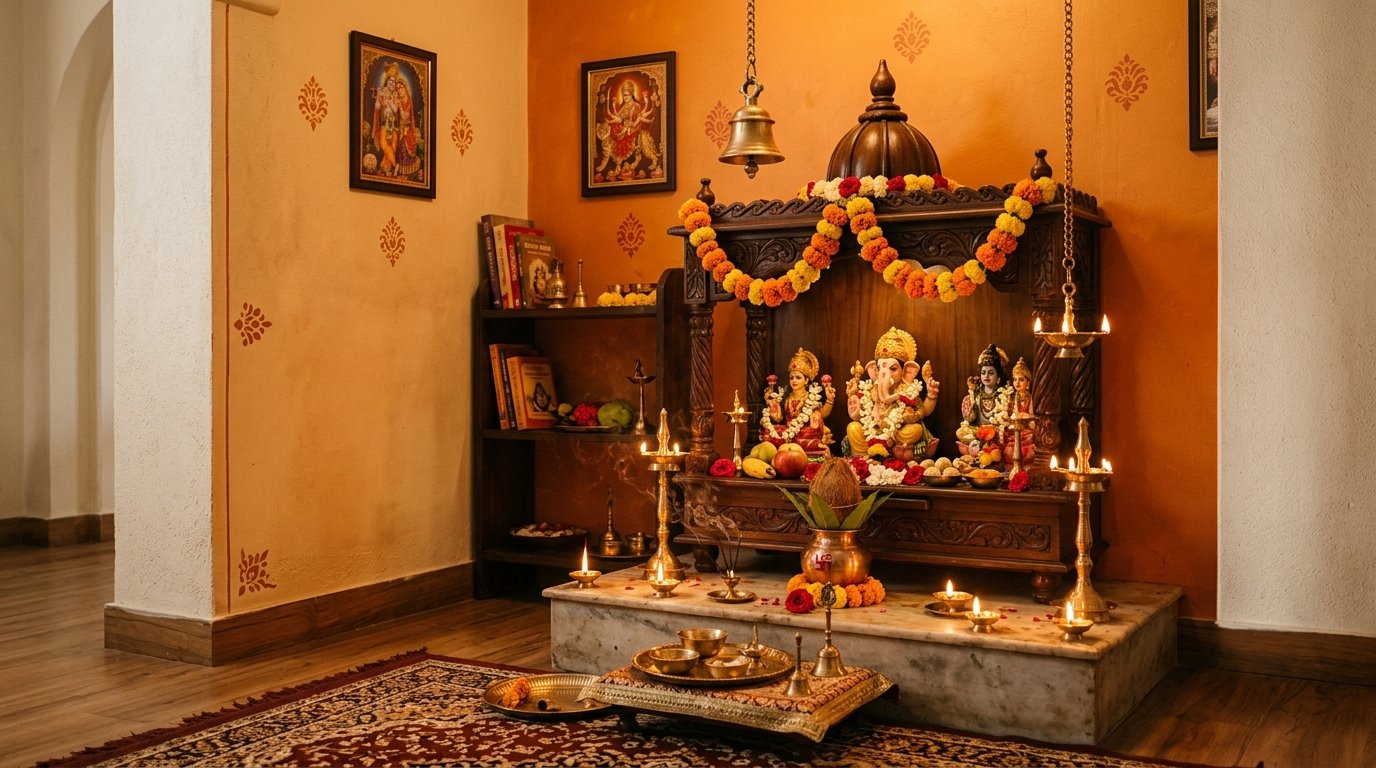
In virtually every Indian home — from a compact 1BHK flat in a Bengaluru apartment complex to a sprawling bungalow in Ahmedabad or Jaipur — the pooja room occupies a singular position. It is the most personal room in the house. It is the first room entered in the morning and the last thought of at night. It is where the family gathers for festivals, where children learn rituals passed down through generations, and where the weight of a difficult day is quietly placed before the deity and left behind.
Given this significance, it is genuinely surprising how often the pooja room is treated as an afterthought during a home renovation or repaint. The living room gets careful colour consultation. The master bedroom gets the accent wall treatment. The kitchen gets a thought about moisture resistance. And the pooja room — the room that deserves the most considered specification of all — gets a coat of whatever white or cream was left over from the other rooms, applied quickly before the painter moves on to the next job.
This guide corrects that. It covers every dimension of pooja room paint specification: the colours that support the devotional quality of the space, the finishes that survive the specific challenges of incense smoke, diya soot, kumkum stains, and daily flower water, the preparation required for a surface that looks immaculate under the warm glow of a brass diya, and the practical Vastu guidance that aligns traditional spatial wisdom with modern paint choices.
Why the Pooja Room Demands a Different Paint Specification
Before getting to colour and finish choices, it is worth understanding what makes the pooja room a genuinely different painting environment compared to any other room in the house. The challenges are specific and consistent across Indian homes regardless of region or community.
Incense smoke is the most significant factor. Most Indian pooja rooms are lit with agarbatti, dhoop sticks, or camphor on a daily basis — sometimes multiple times a day. The combustion of incense releases fine particulate matter, tar compounds, and airborne oils that deposit on nearby wall surfaces over time. On an unsealed or poorly specified wall, this deposit builds up as a greasy, discoloured film that cannot be wiped clean without damaging the paint underneath. A properly specified wall — one that uses a hard, smooth, semi-wipeable finish — allows these deposits to be gently cleaned away with a soft damp cloth without leaving permanent staining or paint damage.
Diya and lamp soot is a related but distinct challenge. The concentrated soot produced by burning ghee or oil in a brass diya deposits in a characteristic pattern directly above and behind the lamp, creating dark staining on the wall behind the mandir. This soot contains carbon particles bound in an oily matrix. On a standard matte interior emulsion, this type of staining bonds chemically with the paint and cannot be removed — it can only be painted over. On a low-sheen or eggshell finish with adequate binder hardness, gentle cleaning with a mildly alkaline solution can lift the majority of the deposit before it sets permanently into the paint film.
Kumkum and turmeric splatter from daily rituals creates vivid, concentrated staining that is notoriously difficult to remove from any painted surface. The pigments in kumkum (red powder) and turmeric (haldi) are highly reactive dyes that bond rapidly with porous substrates. The only reliable protection is a wall surface with minimal open porosity — achieved through proper priming and a finish coat with adequate resin content — so that ritual splatter sits on the surface long enough to be wiped rather than being absorbed immediately into the wall.
Moisture from flower offerings and cleaning adds a final challenge. The area immediately around the mandir is wiped down regularly, flowers placed in water containers create minor daily spillage, and the floor washing that accompanies morning puja sends moisture vapour onto the lower walls. A wall finish without adequate moisture resistance will begin to show dampness rings, chalking, and localised paint failure within months in an actively used pooja room.
Colour Families That Work in the Pooja Room
The pooja room is one interior space where traditional wisdom and the science of light and colour perception genuinely converge. The colours associated with sacred and devotional spaces across Indian traditions — saffron, ivory, pale gold, soft turmeric yellow, lotus pink, pristine white — are not merely conventional choices. They carry specific optical and psychological properties that make them genuinely effective in this particular room.
Warm ivory and off-white is the single most versatile and enduringly successful colour for pooja room walls. It reflects the warm light of diyas, camphor flames, and brass oil lamps in a way that no cool or neutral white can match. Pure brilliant white reflects artificial light with a slightly cold quality that can make the warm amber tones of traditional lamp light feel clinical. Warm ivory, with its subtle yellow or cream undertone, amplifies the warmth and softness of diya light, making the space feel genuinely luminous during morning and evening puja. It is also the most forgiving background for the gold, red, and orange tones of deity idols, brass urns, marigold garlands, and silk cloth draping that typically fill a pooja room — these traditional colours stand out with clarity and richness against a warm ivory ground without competing with each other.
Saffron and warm ochre is the colour most immediately associated with Indian devotional spaces, and for genuine optical reasons. In Hindu tradition, saffron (kesari) represents purity, fire, renunciation, and spiritual energy. When used as the primary wall colour of a pooja room — or applied as the wall directly behind the main deity — it creates an enveloping warmth that makes the space feel dedicated, purposeful, and spiritually distinct from the rest of the house. This distinction matters: the pooja room functions better as a space of devotion when it feels visually separate from the living areas. Saffron achieves this effectively. The practical note for a full room treatment is to choose a mid-depth saffron rather than a very dark shade — a pale to mid-tone saffron maintains the warmth without making a small pooja room feel enclosed. A deeper saffron works beautifully on the feature wall behind the mandir, with a warm ivory on the remaining three walls to balance the intensity.
Pale turmeric yellow and soft gold offer an alternative to saffron that is warmer in tone and slightly less intense, making them an excellent choice for smaller pooja rooms or for homes where the family prefers a more restrained palette. The gentle warmth of a pale turmeric wall creates the same amplification of diya light that ivory achieves, but with just enough colour to distinguish the room clearly from the neutral tones of the rest of the house. Under warm LED lighting and especially under the dancing light of multiple diyas, a pale turmeric wall has a quality that is difficult to describe accurately — it seems to emit warmth rather than simply reflect it.
Pristine white with warm undertone is the preferred choice in many South Indian Hindu traditions, and in Jain and Sikh pooja spaces, where white represents purity and simplicity. The critical distinction here is the undertone: a white with a warm beige or cream base holds beautifully under warm lamp light, while a cool or blue-white can read as slightly grey or fluorescent under the same conditions. If white is the intended choice, specifying a warm white with an LRV (light reflectance value) of 85 to 90 rather than pure brilliant white at 95+ produces the better result in a devotional space.
Soft lotus pink and pale rose are traditional colours for Vaishnavite and some Shakta pooja spaces, associated with devotion, love, and the lotus — a central symbol in many forms of Hindu worship. These tones work best as the wall colour directly behind the deity or applied across all four walls of a compact pooja alcove. The critical requirement is to stay in the pale, dusty register of these tones — not the vivid pink of a children's room, but a muted, slightly warm rose that harmonises with gold, brass, and orange floral offerings without overwhelming them.
Vastu Principles and Paint Colour — Where Tradition and Specification Meet
Vastu Shastra, the ancient Indian system of spatial arrangement, has specific recommendations for the pooja room that align closely with the practical colour guidance above. Understanding the Vastu principles helps explain why certain traditional choices work so effectively in this space.
Vastu recommends situating the pooja room in the northeast corner of the home — the Ishan kona — which receives the morning sun directly from the east. The northeast is associated in Vastu with water, purity, and spiritual energy. In terms of natural light, a northeast-facing pooja room receives clear morning sunlight, which is the warmest and most golden quality of daylight. Wall colours that harmonise with warm morning light — ivory, pale saffron, warm yellow — perform exceptionally well in a northeast pooja room for this practical reason: the morning light coming through the window amplifies the warmth in these wall tones, making the room look most beautiful precisely during the morning puja, which is the primary ritual occasion of the day.
For the colour of the main wall (the wall behind the deity, which faces east or northeast), Vastu recommends white, cream, yellow, and light orange. These correspond exactly to the ivory, turmeric yellow, and saffron tones recommended above for their optical properties — a convergence of traditional and practical wisdom that is worth noting. Vastu specifically cautions against dark colours, heavy greys, and black in the pooja room, which aligns with the practical recommendation to keep the space light and reflective to maximise the effect of warm lamp light.
The Right Finish for a Pooja Room: Balancing Cleanability and Light Quality
The choice of finish for a pooja room wall requires more careful thought than for any other room, because the finish determines two things simultaneously: how the wall responds to diya light and incense deposits, and how cleanable the surface is against the specific soiling challenges of a devotional space.
A full matte finish — though beautiful in its light quality and deeply faithful to traditional interior aesthetics — is not the ideal specification for a pooja room. Matte surfaces are porous and absorb incense deposits, kumkum staining, and diya soot with no ability to recover. Within months of regular use, a matte pooja room wall will show darkening around the incense holder, staining near the mandir, and a general greying of the lower portions of the walls from daily cleaning splatter.
Low-sheen or eggshell finish is the recommended specification for pooja room walls. Eggshell finish presents a surface that is visually close to matte — it has a very slight, soft sheen that reads as satiny in raking diya light without the visual disruption of a semi-gloss or silk finish. Crucially, the slightly increased resin content of an eggshell surface provides meaningful resistance to surface soiling and allows gentle cleaning with a soft damp cloth without paint damage. For the specific soiling profile of a pooja room — incense deposits, lamp soot, ritual powder splatter — eggshell is the correct balance of visual quality and practical durability.
For the area immediately behind the mandir — the most intensive soiling zone — consider applying the same colour in an interior silk or semi-gloss finish in a confined area of approximately 60cm to 90cm around the deity alcove. This higher-durability finish for the highest-contact zone can then be blended into the surrounding eggshell without visible demarcation if the colour is matched precisely.
Surface Preparation: Why Pooja Room Walls Need Extra Care
The pooja room may be one of the smaller rooms in the house, but its surface preparation deserves more attention, not less. The room is seen at extremely close range — you sit or kneel within inches of the walls during puja, you look directly at the surface at eye level — and any surface defect is immediately visible. More practically, in most Indian homes the pooja room wall behind the mandir has accumulated years of diya soot, incense residue, and ghee deposits that must be properly treated before new paint can be applied with any durability.
Start by wiping down all existing wall surfaces with a clean cloth dampened in a dilute solution of washing soda — approximately 50 grams dissolved in five litres of warm water. This mildly alkaline solution cuts through grease and incense residue without damaging the existing paint or plaster. Work from the top of the wall downward, rinsing with clean water after the wash. Allow the walls to dry for a minimum of 48 hours before proceeding.
If the wall behind the mandir shows dark soot staining that does not respond to cleaning, seal it with a shellac-based stain-blocking primer before applying the finish coat. Standard acrylic primers will not block carbonaceous soot stains — they will bleed through even three or four coats of emulsion. A single coat of shellac primer seals the stain permanently and provides an excellent bond for the decorative topcoat.
Fill any cracks or surface imperfections with a quality interior acrylic filler and sand smooth once dry. For pooja rooms with older plaster that shows significant surface roughness or previous lime wash applications, a full skim coat or wall putty treatment followed by sanding will provide the smooth, dense surface that an eggshell finish requires to look its best. Apply a good quality interior primer across all walls to unify porosity and ensure the topcoat colour reads consistently without patchiness.
Application Tips for a Flawless Pooja Room Finish
The pooja room is typically small, with limited roller access around the mandir and detailed corner work near the niche or alcove. Brush application is often required for significant portions of the room, and brush marks are visible in a small room under warm light. Use a high-quality fine-bristle brush for cut-in work around corners, the ceiling line, and around the mandir alcove. Take your time with the cut-in — this is where most amateur applications show the most visible quality difference.
For the main wall areas, a small, short-nap roller (7mm nap, 7-inch roller) gives a smoother finish in the tight space of a pooja room than a standard 9-inch roller. Apply in a cross-hatch pattern — first vertically, then horizontally across the same section before moving on — to distribute the paint evenly and minimise the lap marks that can be visible in confined spaces with concentrated warm light sources. Two full, even coats are always more effective than one thick coat that sags and shows application marks.
Allow the first coat to dry for a minimum of four hours in normal Indian monsoon humidity conditions — longer if humidity is above 80%. The second coat applied over a properly dried first coat bonds chemically to it, producing a unified film with proper thickness and hardness. Rushing the second coat onto a wet or partially dry first coat is the most common cause of peeling and uneven sheen in small rooms.
The Zorvanta Recommendation for Pooja Rooms
At Zorvanta Paints, we understand that the pooja room is not just another interior space — it is the room in your home that deserves the most carefully chosen paint. Our Deco Gold Pro interior emulsion in low-sheen and eggshell finishes, tinted to warm ivory, pale saffron, soft turmeric yellow, or lotus white, delivers the combination of light quality, cleanability, and durability that a daily-use devotional space demands. Our Zorvanta Acrylic Deep Penetrating Primer seals incense deposits and old soiling before your new colour goes on, ensuring the finish looks immaculate from day one and continues to look that way through years of regular ritual use.
We can assist with colour selection tailored to your pooja room's orientation, its natural light quality, and your family's traditional colour preferences — whether saffron for a north Indian Vaishnava space, pristine warm white for a south Indian pooja room, or pale gold for a Jain or Sikh prayer corner. Explore our full interior paint range, read our guide on colour psychology in interior spaces, or contact our team for a room-specific consultation and quotation.
Frequently Asked Questions (FAQs)
1. Which colour is best for a pooja room wall according to Vastu?
Vastu Shastra recommends white, cream, light yellow, and pale orange for pooja room walls — particularly the wall behind the main deity that faces east or northeast. These colours align with the practical recommendation to use warm, light-reflective tones that amplify the quality of diya light and morning sunlight in the devotional space.
2. How do I remove diya soot and incense stains from pooja room walls before repainting?
Wash the stained area with a dilute washing soda solution (50g per 5 litres of warm water) using a soft cloth. For persistent carbonaceous soot stains that survive cleaning, apply a single coat of shellac-based stain-blocking primer before the decorative topcoat. Standard acrylic primers will not block these stains — only shellac seals them permanently.
3. Can I use matte paint in a pooja room?
Matte finish is not recommended for the main pooja room walls because it absorbs incense deposits, kumkum staining, and diya soot without any ability to be cleaned. Low-sheen or eggshell finish is the better choice — it has a very similar visual quality to matte in warm diya light but can be gently wiped clean of surface deposits without paint damage.
4. Should I use special paint in the pooja room to prevent incense discolouration?
Incense discolouration is minimised by three factors: a properly sealed surface with a good primer before painting, a finish with some eggshell hardness (which resists deposit bonding), and regular gentle cleaning of the wall surface. A quality low-sheen emulsion over proper primer will show significantly less discolouration from regular incense use than an unprimed or matte-finished wall.
5. How often does a pooja room need repainting in an Indian home?
A properly painted pooja room using a quality eggshell or low-sheen emulsion, maintained with periodic gentle cleaning, should hold its appearance for five to seven years even with daily ritual use. The most common reason for earlier repainting is soot accumulation behind the mandir alcove — which is why the higher-durability silk finish behind the deity is a practical investment. Annual gentle cleaning with a soft damp cloth around the diya and incense areas significantly extends the clean life of the finish.
Need help choosing the right finish?
Talk to our team or request a tailored quotation for your project.