Rental Apartment Painting Guide: Smart Wall Upgrades for Indian Tenants Without Losing Your Deposit
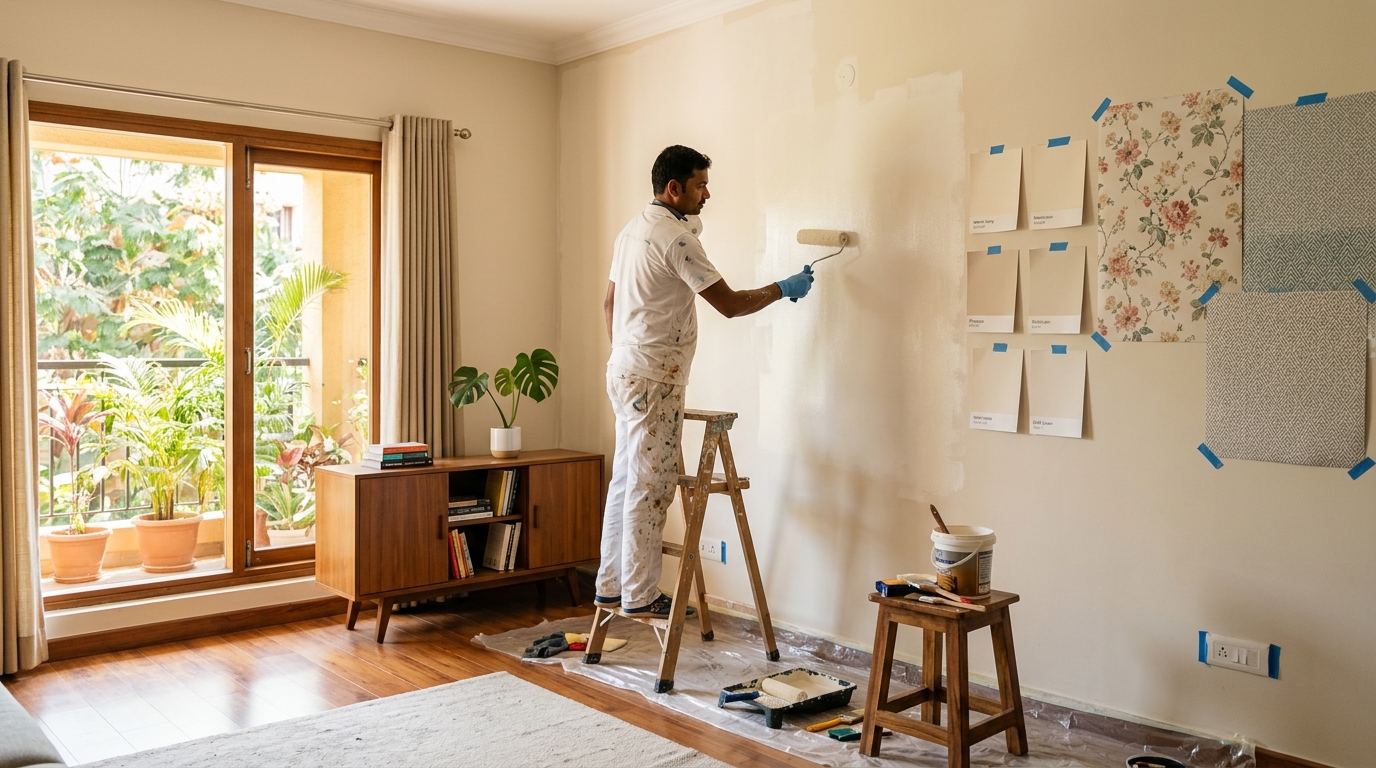
Renting is the everyday reality for tens of millions of Indians — students in Pune and Bengaluru, young professionals in Mumbai and Delhi, migrant workers in Surat and Hyderabad, families waiting to buy in Chennai and Ahmedabad. The rented flat is home for months or years at a stretch, but the walls remain firmly in the landlord's domain: that particular shade of contractor beige, the patchy off-white from the last tenant's repaint, the yellowing cream that absorbs cooking fumes and incense smoke with equal patience. The instruction from the rental agreement is always the same — do not touch the walls.
Yet the quality of your surrounding walls matters for reasons that go well beyond decoration. The visual environment of a living space has a real effect on mood, sleep quality, and how deeply a place feels like home. Spending two or three years staring at peeling beige walls and the previous occupant's scuff marks is not a neutral experience — it contributes to the mild, persistent dissatisfaction that makes renters feel permanently temporary in their own homes.
The good news is that "do not touch the walls" is far less absolute than most tenants assume. There is a full spectrum of legitimate, responsible, deposit-safe approaches to improving the painted environment of a rental flat — from approaches requiring no landlord involvement whatsoever, through negotiated painting agreements that benefit both parties, to full repaints properly planned, executed, and reversed before move-out. This guide covers every level of that spectrum.
Start With the Rental Agreement: What It Actually Says
Before touching a single wall, read your rental agreement carefully. Most standard Indian rental agreements contain a clause about alterations — typically something like: "the tenant shall not make any structural or cosmetic alterations to the premises without the written consent of the landlord." The operative phrase is written consent. The clause does not prohibit painting outright; it requires permission. That is an opening for a conversation, not a door firmly closed.
Many landlords in Indian cities are far more receptive to tenant painting than tenants assume — particularly where the tenant is long-standing, reliably pays on time, and maintains the flat well. The landlord's real concern is not that you will choose a different colour. The concern is that you will leave the flat in a condition harder to re-let: vivid feature walls requiring five coats to cover, textured finishes impossible to reverse cleanly, or paint applied carelessly over surfaces that were in decent shape. Address those concerns directly and honestly, and many landlords will agree to a workable arrangement.
The most effective approach is a simple written painting proposal — a note or email listing what you intend to paint, which rooms, which walls, the colours proposed (stay neutral), and your commitment either to restore the walls to the original colour before vacating or to reimburse the landlord for repainting costs. This document protects the tenant against arbitrary deposit deductions and gives the landlord a clear record of what was agreed. A brief email exchange confirming consent is legally adequate and practically sufficient.
The Tenant Colour Rule: Stay Firmly in Reversible Neutral Territory
If you have obtained permission to paint — or are in a rental situation where the landlord has agreed to let you personalise the flat — the single most important principle is to stay in the reversible neutral register. This means light, clean tones in the warm white, soft ivory, pale sage, muted green, or warm grey family. These are universally acceptable to future tenants, easy for landlords to retain after you leave, and require only a single coat of standard white emulsion to cover cleanly when your tenancy ends.
The practical reason this matters is purely financial. A vivid feature wall — a deep teal, a burnt orange, a charcoal grey — that you love and the landlord has agreed to becomes a significant problem at move-out. Deep colours require three to five coats of white emulsion to cover completely. That means either a substantial painting cost at your own expense on departure, or a deposit deduction that compensates the landlord for that work. By staying in the light neutral range, you achieve a genuinely better-looking home while keeping the move-out restoration obligation simple and affordable — one coat, one afternoon, done.
Within the neutral range, meaningful creative improvement is still absolutely possible. A warm off-white with a cream undertone feels qualitatively different from blank contractor white — it glows under warm artificial lighting and makes the flat feel cared-for. A pale sage in the bedroom creates a different sleeping environment without requiring elaborate reversal. A soft warm grey in the living room gives a settled, considered quality that furniture arrangement alone can never achieve over bare white walls. The creative latitude within the reversible neutral palette is broader than most tenants realise.
The Same-Colour Refresh: The Invisible Upgrade
One of the least discussed but most effective techniques is the same-colour repaint — applying a fresh coat of precisely the same shade the landlord originally used, but in a higher quality paint than the contractor-grade stock typical of Indian rental flats. This is maintenance, not alteration. No permission is required because nothing about the flat's specification changes. And the improvement it delivers is remarkable.
Contractor-grade emulsions used in most Indian rentals are low-binder, high-filler formulations. They cover adequately for the first year but chalk, yellow, and look tired by the second. A quality interior emulsion — with a higher resin content, better pigment dispersion, and proper film thickness — on the same colour delivers a surface that is richer, cleaner, and far more pleasant to live with. The flat looks repainted without actually changing anything about its specification. The landlord inspects the flat and finds it in better condition than before you touched it.
To achieve this correctly, cut a small paint chip from the wall — a corner behind a wardrobe or bookshelf, or inside a built-in cupboard — and take it to a quality paint supplier for a spectrophotometer colour match. Apply the matched colour in a quality low-VOC emulsion over clean, lightly sanded walls. The result is indistinguishable from the original to any casual inspection but materially better in surface feel, light reflectance, and durability.
Choosing the Right Paint Formula for Rental Use
The specific requirements of a tenant's paint choice differ meaningfully from those of an owner-occupier. The paint must go on smoothly over existing paint without elaborate preparation. It must achieve good coverage in as few coats as possible, reducing cost and effort. And it must be easy to cover with a standard white emulsion when the tenancy ends.
High-opacity, self-priming emulsions are the most practical choice for tenant repainting. These formulations adhere well to existing painted surfaces without a separate primer coat — essential in a rental context where stripping back to bare plaster is not realistic. They build adequate film thickness in two coats rather than three, reducing both time and material cost. They have the pigment density to deliver a clean, consistent finish even over the slightly uneven and previously marked walls typical of Indian rental flats.
Low-VOC or zero-VOC formulations are particularly important when you are living in the flat during or immediately after painting. Standard solvent-borne paints require 24 to 48 hours of ventilation and can cause headaches, eye irritation, and respiratory discomfort in enclosed spaces — a serious practical problem in a compact Indian flat. Modern acrylic emulsions with very low VOC content are dry to a liveable standard within two to four hours and reach full cure within 24 hours, making them genuinely compatible with the reality of tenant life.
Avoid textured finishes, masonry coatings, or oil-based paints in any rental context. Textured finishes are nearly impossible to reverse cleanly. Masonry paints bond to the substrate differently from standard emulsions and can create adhesion issues for the next painter. Oil-based finishes yellow over time and are difficult to cover with water-based topcoats — creating complications that can fairly be charged back to you at move-out.
Surface Preparation in a Rental Flat: The Restrained Approach
Surface preparation in a rental context requires restraint. You are not stripping back to bare plaster or applying full skim coats. The preparation goal is to get the existing surface into the best possible condition for a fresh topcoat, nothing more.
Start by washing all walls with a dilute all-purpose cleaner and a soft sponge, paying careful attention to greasy areas near the kitchen, marks near light switches, and finger-contact zones around door frames. Allow walls to dry fully — at least 24 hours in Indian humidity conditions — before proceeding. Lightly sand any rough patches or raised edges with a fine-grit sanding block (180 to 220 grit), taking care not to cut through the existing paint to bare plaster. Wipe off all sanding dust with a clean dry cloth before applying any paint.
Fill small holes — nail holes, minor wall damage — with a lightweight ready-mix acrylic filler, applied flush with a scraper and sanded smooth once dry. A lightweight acrylic filler in a thin layer, sanded flat and dusted off, is the correct approach for the kind of minor repairs typical in a rental interior. Do not use heavy-bodied filler or cement-based patching compound in a rental flat — these require longer drying times, are difficult to sand smooth, and can create adhesion complications for the topcoat.
If the existing paint is peeling, cracking, or chalking significantly, be honest about whether painting over it is appropriate. Applying new paint over a failing existing coat will not produce a durable result — the new coat simply follows the old one as it continues to delaminate. In this situation, the correct course is to raise the matter with the landlord as a maintenance issue. A landlord informed that their flat's existing paint is failing is in a far better position than one who discovers failed paint after the new tenant has moved in.
Restoring the Flat to Original Condition Before Moving Out
Planning your exit is as important as planning the paint going in. Before you apply any colour, photograph every wall thoroughly — under good lighting, from multiple angles — to create a documented record of the walls' condition before your work. This photography protects you against arbitrary deposit deductions: if a mark or defect appears after you vacate, you have a clear record of whether it pre-dated your involvement.
When the time comes to move out, your restoration obligation depends on what was agreed in writing. If the agreement was to restore the original colour, this requires painting your neutral with a colour-matched version of the original shade. Because you stayed in the neutral range, this is almost always achievable in a single coat of a high-opacity emulsion. If the original was a similar neutral, the restoration may be genuinely indistinguishable from the factory condition.
Schedule restoration painting for the final week of your tenancy — after furniture is removed, while you still have full access, and with enough time for the paint to dry and the flat to ventilate before the landlord inspection. A freshly painted flat, even in the original contractor colour, makes a significantly better impression at the move-out walk-through than a flat showing three years of accumulated wear. That impression is directly related to how quickly and how fully your deposit is returned.
The Zorvanta Approach for Rental Interiors
At Zorvanta Paints, we understand that the requirements of a rented home differ meaningfully from those of a permanent one. Our Deco Gold Pro interior emulsion in matte and low-sheen finishes is our recommended specification for tenant painting: self-priming over existing painted surfaces, excellent coverage in two coats, available in our full range of neutral tones, and easy to cover cleanly at move-out with a single coat of white. Our colour matching service enables precise replication of an existing shade — both for the initial same-colour upgrade and for the move-out restoration coat.
Whether you are planning a full negotiated repaint, a single-room bedroom improvement, or a quality refresh of tired walls in the original shade, our team can assist with paint selection, colour matching, and application guidance tailored to a rental context. Explore our interior paint range, read our guide on how colour transforms the feeling of a room, or contact our team for a consultation designed around your specific rental situation.
Frequently Asked Questions (FAQs)
1. Can I paint my rental flat walls without the landlord's permission in India?
Most rental agreements require written consent before cosmetic alterations, which includes painting. Refreshing the walls in the same colour using a matched shade is generally considered maintenance rather than alteration and typically does not need explicit permission. For any colour change, obtain written agreement from your landlord first — an email confirmation is sufficient — to protect your deposit.
2. What is the safest wall colour to use in a rented flat in India?
Light, warm neutrals — soft off-whites, pale sages, warm greys, and muted creams — are the safest choices for tenant painting. They are easy to cover with a single coat of standard white emulsion at move-out, broadly acceptable to landlords and future tenants, and represent a genuine, comfortable improvement over typical contractor white without creating any reversal difficulty.
3. How do I restore rental flat walls to the original colour before moving out?
Take a paint chip from the wall — from behind furniture or inside a built-in cupboard — and have the colour matched at a quality paint supplier using a spectrophotometer. Apply the matched colour in a high-opacity emulsion over your chosen neutral. In most cases a single coat achieves a clean, acceptable result if the neutral you used is light in tone. Schedule this in the final week before move-out to ensure the paint is fully dry for the landlord inspection.
4. Can a landlord deduct my deposit for painting the walls a neutral colour?
If you obtained written permission before painting and have restored the walls as agreed, a landlord has very limited grounds for a deposit deduction related to the paint. If you painted without permission, the landlord can legitimately deduct the cost of restoration repainting. Written consent before you start — and photographic documentation of the pre-painting condition — is the essential protection against this outcome.
5. Which paint finish is best for rental flat walls?
Low-sheen or eggshell finish is ideal for rental interiors. It looks nearly identical to matte under normal lighting, but can be wiped clean of the day-to-day marks that accumulate in a lived-in space. It is also easier to paint over cleanly at move-out than a high-gloss finish, which shows every surface imperfection and creates a strong sheen difficult to cover in a single restoration coat.
Need help choosing the right finish?
Talk to our team or request a tailored quotation for your project.