Painting Railings, Grills & Gates: Anti-Rust & Metal Finish Guide
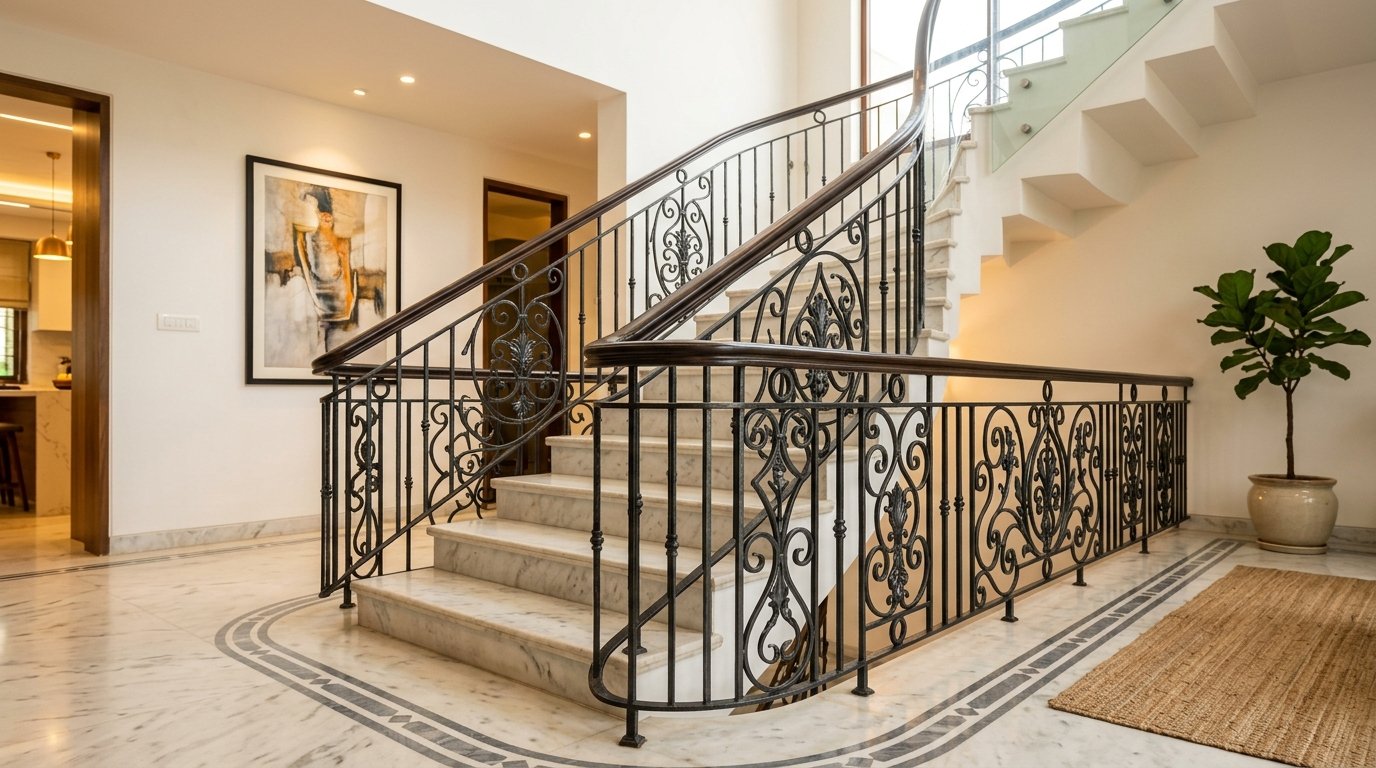
Walk through any Indian neighbourhood — urban apartment block, independent villa, or three-storey row house — and you will find iron and mild steel railings, window grills, and gate structures at the boundary of almost every home. These metal elements are structural, functional, and highly visible. They are also among the most neglected surfaces when it comes to painting and maintenance. A gate that was painted at the time of installation five years ago may now be half-covered in rust, with the original black paint lifting in flakes. A staircase railing that has seen ten monsoon seasons without repainting may be structurally sound but visually exhausted. The standard response — a quick coat of black enamel slapped over the rust — is not a solution. It is a postponement of the same failure, usually arriving within a single season.
The good news is that iron and mild steel railings, grills, and gates respond extremely well to a correctly executed painting system. The metal substrate itself is stable, the surfaces are accessible, and the results of doing it right are both visually dramatic and genuinely long-lasting. A properly prepared and correctly coated railing or gate can hold its finish for five to eight years even under Indian monsoon conditions — including in coastal cities where salt-laden air accelerates corrosion significantly. This guide explains exactly what that correct system looks like, from the first scraper stroke to the final decorative topcoat.
Understanding Why Metal Railings and Grills Rust — and Why Quick Fixes Fail
Iron and mild steel corrode when iron, oxygen, and moisture are simultaneously present at the metal surface. In most of India, two of those three ingredients — oxygen and moisture — are abundant for six months of every year during and after the monsoon season. The third, bare iron, becomes available the moment a coating system develops any breach: a chip from a hard contact, a hairline crack in an aged paint film, a joint or weld where paint adhesion was poor from the start, or an area of rust that formed under the paint before it was applied and is now lifting the film from beneath.
Once rust forms at a breach, it expands. Iron oxide occupies significantly more volume than the iron it formed from — roughly three to four times the volume — which means that a small rust spot pushes the surrounding paint film outward, creating blistering that spreads. A rust patch one centimetre in diameter at the start of the monsoon can be five or six centimetres across by the end of it. This is why spot-painting over rust without treating the metal beneath it never holds. The rust beneath the fresh paint continues expanding, and the new paint lifts within weeks.
The other common failure pattern is applying topcoat directly over a rusty or poorly prepared surface without a proper primer. Decorative enamel topcoats — even excellent ones — are not formulated to bond to rust or to loose, flaking old paint. Their function is to provide colour, sheen, hardness, and surface protection over a correctly prepared and primed substrate. When that substrate preparation has been skipped or done inadequately, the topcoat fails early regardless of its quality. This is why the preparation phase of any metal painting job is far more important than the topcoat choice.
Step One: Full Assessment and Rust Removal
Before any product is applied, every surface of the railing, grill, or gate must be assessed for its current condition. Work systematically — look at joints and welds first, because these are areas where moisture accumulates and coating adhesion was often poorest at the original installation. Check the lowest sections of vertical members and the horizontal base bar closest to the floor or ground, where moisture contact is highest. Look for any area where the paint is bubbling, blistering, or has developed orange-brown staining beneath the surface that indicates sub-surface rust.
All loose and flaking paint must come off. A wire brush — hand wire brush for smaller areas and detailed sections, wire cup brush attachment on an angle grinder for larger flat sections — is the primary tool for this stage. Work the wire brush over every area of rust and loose paint until the surface is clean and the surrounding paint edges are feathered to a firm edge. On heavily rusted sections, a rust remover or rust converter applied after the mechanical clean-up provides an additional chemical treatment step that neutralises any residual rust compounds that the wire brush cannot physically remove. Rust converter transforms the iron oxide at the surface into a stable, paintable compound. Allow it to dry and cure fully according to the product instructions before proceeding — rushing past this stage is one of the most common causes of premature coating failure on metal.
For surfaces that are heavily scaled or have multiple layers of old paint in varying states of adhesion, a chemical paint stripper applied to the entire surface — followed by complete wire brushing — produces the cleanest possible starting substrate. This is the most time-consuming route, but on a badly neglected railing or gate it is genuinely the only approach that produces a result that will last. A partial clean-up on a heavily compromised surface means the new system is as strong as its weakest point, which is wherever the old failing paint was left in place.
Step Two: Selecting and Applying the Right Primer
Priming is not optional on metal surfaces. The primer performs functions that no topcoat can replicate: it bonds directly to the metal or treated substrate, it provides a barrier against moisture penetration to the metal surface, and it gives the topcoat a stable, chemically compatible surface to bond to. Skipping primer on iron and steel and applying topcoat directly — a common shortcut on site — produces a system that looks fine for a few weeks and fails by the end of the first monsoon.
For railings, grills, and gates in Indian conditions, the correct primer choice depends on the location and corrosion exposure of the surface. A red oxide primer is the standard, cost-effective specification for most interior staircase railings and protected exterior locations — balcony railings shielded from direct rain, internal courtyard grills, and similar sheltered metal. Red oxide primer has good adhesion to clean or lightly treated mild steel and provides a dependable base for enamel topcoats. It is widely available, straightforward to apply by brush, and appropriate for the majority of residential metal painting situations.
For exposed exterior gates, compound boundary grills, and any metal surface in a coastal location within five to ten kilometres of the sea, an epoxy primer or a zinc phosphate primer provides significantly superior corrosion resistance. These primers form a harder, more chemically resistant film than standard red oxide, and zinc phosphate primers specifically inhibit the electrochemical corrosion process at the metal surface. The additional cost is justified on high-exposure surfaces where durability over multiple monsoon seasons is the goal.
Apply primer in a uniform, continuous coat — not thick, not dripping, but complete with no skips or holidays, particularly at joints, welds, and any section where the metal geometry makes brush access difficult. The areas that are hardest to reach are also the areas where moisture will concentrate — take the time to prime them correctly. Allow the primer to cure fully before applying topcoat. Applying topcoat over undercured primer traps solvent in the film and produces a system that is soft, prone to print, and significantly less durable than correctly cured primer.
Step Three: Choosing the Right Topcoat — Finish and Function
The topcoat on a metal railing or gate performs two jobs simultaneously: it protects the primer and the metal beneath it, and it delivers the visual character of the finished surface. Getting the topcoat selection right means understanding both dimensions of the decision.
Synthetic enamel — the traditional oil-based enamel — has been the standard metal topcoat for Indian railings and grills for decades, and for good reason. It produces a hard, smooth, high-gloss film with good abrasion resistance and reasonable weatherability. It is available in a wide colour range, dries to a strong mechanical film, and is genuinely durable on metal when applied over a correct primer system. Standard black synthetic enamel on a red oxide primed mild steel railing, done correctly, will hold its finish for two to three years under normal exposure conditions. For a decorative option that looks like cast iron — smooth, high-gloss black — synthetic enamel remains the most accessible and cost-effective topcoat for most residential railings and grills.
Hammer finish enamel is an oil-based enamel that dries to a distinctive textured surface that resembles hammered metal. It is one of the most popular decorative choices for Indian gates and railings because it combines visual character with a practical advantage: the textured surface hides minor surface irregularities in the metal and any slight unevenness in the application far better than a smooth gloss finish. Hammer finish paints typically contain small metallic flakes that produce the distinctive shimmer in the cured film. They are available in black, silver, bronze, and dark green — colours that work well on the ornamental ironwork that is common in Indian staircase railings and decorative gates. Hammer finish enamel applied over red oxide primer produces a finish that can hold its appearance for four to five years even under moderate outdoor exposure.
Polyurethane enamel (PU enamel) is the premium specification for metal surfaces where long-term colour retention, scratch resistance, and gloss retention are priorities. PU enamel topcoats outperform standard synthetic enamel in every measurable durability parameter — they are harder, more chemically resistant, more UV-stable, and more resistant to chalking and fading on outdoor exposure. On a main gate that is the visual centrepiece of the property, or on any decorative railing where the finish needs to hold its appearance for five to eight years, a PU enamel topcoat over an epoxy primer is the system to specify. The cost is higher than synthetic enamel, but the extended service life before the next repaint cycle means the total cost of ownership over ten years is comparable and often lower.
Application Techniques for Clean, Streak-Free Results
Metal railings and grills are among the most technically demanding surfaces to paint neatly. The complex geometry — bars, scrollwork, joints, welds, ornamental sections — means that brush technique and product viscosity both matter significantly. Working carelessly produces runs, sags, and uncovered areas that will be obvious against the light.
Use a small to medium-sized natural bristle brush for detailed metalwork. A round or filch brush — the narrow, pointed type used for detail work — is the right tool for painting decorative scroll sections, curved members, and any area where a flat brush cannot make full contact with the surface. A wider flat brush handles straight vertical and horizontal bars efficiently. Avoid overloading the brush with paint — a thin, well-worked coat covers better and dries to a more even film than a thick, heavy application that sags before it dries.
Work systematically from the top of the structure downward, and from the back face (least visible) to the front face (most visible). This sequence ensures that any drips from higher sections are captured in subsequent brush strokes on the sections below, and that the most visible face gets the final coat pass. On ornate scrollwork, paint the hidden recesses first, then work outward to the visible faces. On straight balusters or vertical bars, paint in a single continuous stroke from top to bottom to avoid lap marks.
Two thin coats are always better than one thick coat. The first coat seals the primer and provides the colour foundation; the second coat fills any thin areas, evens the colour depth, and delivers the final sheen. Allow the first coat to dry fully before applying the second — premature second-coat application is a significant cause of solvent trapping, which produces a soft, slow-drying film that is easily marked by contact.
Painting Window Grills: Specific Considerations
Window grills present a particular set of challenges compared to open staircase railings. The proximity of the grill to window frames, glass, and interior wall surfaces means that paint control is critical — overspray or runs that land on a white wall or a glass pane are immediately visible and difficult to clean after drying. Masking the surrounding wall area and any glass panes adjacent to the grill before starting the painting process is worth the additional preparation time. Use painter's tape on adjacent surfaces and cover glass with old newspaper or plastic sheeting secured with tape.
Window grills in coastal locations — anywhere within five to ten kilometres of the sea in cities like Mumbai, Chennai, Visakhapatnam, Kochi, or Goa — experience significantly accelerated corrosion driven by salt-laden air. The chloride ions carried in coastal air reach the metal surface through any micro-breach in the coating and dramatically accelerate the electrochemical corrosion process. For coastal window grills, an epoxy primer is the minimum specification, and a PU enamel topcoat is strongly recommended. The additional investment in a two-component coating system on coastal metal surfaces pays back through a service life that is two to three times longer than a standard red oxide plus synthetic enamel system in the same environment.
Colour Selection and Decorative Trends for Railings and Gates
Black has been the dominant colour for iron railings and gates in India for generations, and it remains popular for good reason — it reads well against almost any wall colour, it works with both traditional and contemporary architecture, and it does not show weathering and minor surface variations the way lighter colours do. But the range of options has expanded considerably, and choosing a colour that works with the overall colour scheme of the home rather than defaulting automatically to black can produce a significantly more polished result.
Dark charcoal grey — a warmer, slightly less stark alternative to pure black — has become increasingly popular for contemporary homes and works particularly well against white or off-white exterior walls. Bronze and dark brown finishes, available in hammer finish formulations, complement brick and stone exteriors and the warm timber tones that are common in traditional South Indian and Rajasthani architecture. Forest green and dark teal are period-appropriate choices for heritage and Indo-colonial style buildings. For a high-sheen, contemporary look, a polished silver or dark gunmetal grey synthetic enamel on slim-profile stainless-effect MS railings provides a metallic character without the cost of actual stainless steel fabrication.
The Zorvanta Approach to Metal Finishing
At Zorvanta, our metal coating range is designed for the specific demands of Indian residential and commercial metal surfaces — the corrosion challenge of the monsoon season, the UV intensity of Indian summers, and the salt-air environments of India's long coastline. Our red oxide primer provides the dependable adhesion foundation for standard railing and grill applications; our hammer finish enamel and synthetic enamel topcoats are formulated for strong film build, good brushability in site conditions, and colour retention over multiple weathering cycles. For demanding applications — coastal gates, commercial compound grills, and architectural feature metalwork — our zinc phosphate primer and PU enamel topcoat system provides the step up in corrosion resistance and finish durability that high-exposure situations require.
Every metal coating project benefits from the right product combination matched to the actual exposure condition of the surface. Explore our full metal coatings range, read our companion guides on protecting metal surfaces from rust and metal coating durability, or contact our team for a site-specific product recommendation. To get a quotation for your railing, grill, or gate painting project, request one online here.
Frequently Asked Questions (FAQs)
1. Can I paint over rust on my railing without removing it first?
Not effectively. Painting over active rust without removing it first produces a film that looks intact but is separated from the metal by a layer of unstable, expanding iron oxide. The rust continues to grow beneath the paint, which blisters and lifts within one monsoon season. Use a wire brush to remove all loose rust and flaking paint, apply a rust converter to any residual rust, allow it to cure, then prime and paint. Only if the rust is very surface-level and structurally sound can a rust-tolerant primer (one specifically designed to bond to light rust) be used as a shortcut — and even then, mechanical removal of the worst areas first improves the result significantly.
2. What is the best paint for staircase railings in India?
For interior staircase railings with moderate exposure, a red oxide primer followed by two coats of synthetic enamel or hammer finish enamel is the standard, proven system. For exterior railings and gates with full weather exposure, upgrade to a zinc phosphate or epoxy primer, and consider a polyurethane enamel topcoat for longer service life. In coastal locations, the epoxy primer and PU enamel combination is the recommended minimum specification.
3. How long will the paint last on my iron gate?
A correctly prepared and properly applied paint system — proper rust removal, correct primer, two coats of topcoat — will typically last three to five years on an exterior gate under standard Indian monsoon conditions. With a premium PU enamel topcoat over an epoxy primer, service life of five to eight years is achievable. In coastal environments, reduce these estimates by roughly thirty to forty percent unless the premium coating system is used.
4. What is hammer finish paint and why do people use it on gates?
Hammer finish paint is an oil-based enamel that dries to a textured surface resembling hammered or forged metal. It is popular for gates and railings because the texture hides minor surface imperfections and weld marks that would be very obvious under a smooth gloss finish, and because it has a distinctive aesthetic character that works well with traditional ornamental ironwork. It is available in black, silver, bronze, and green, and applies with a standard brush using the same technique as regular enamel.
5. Do I need a professional to paint my window grills, or can I do it myself?
Painting window grills and railings is well within DIY capability provided the preparation is done thoroughly. The painting itself is not technically complex — it requires patience, a small brush for detailed work, and systematic coverage. The preparation — wire brushing, rust treatment, priming — is the demanding part. If the grills are heavily rusted and require significant mechanical cleaning, renting an angle grinder with a wire cup attachment makes the work considerably faster. If the surface is in reasonable condition requiring only light preparation and a repaint, this is a straightforward DIY project that most homeowners can complete over a weekend.
6. Can I use a spray can (aerosol) instead of brush painting for grills?
Aerosol spray cans are convenient for small, decorative sections and for hard-to-reach areas in detailed scrollwork, but they are not economical or practical for painting a full set of window grills or a main gate. They produce a thinner film than brush application, which means less protection per coat, and the overspray control required on a site with adjacent walls and glass makes them more trouble than a brush for most residential metal painting applications. For touch-up work on small areas, aerosols are useful. For a complete repaint of railings or grills, brush application with a good-quality enamel and a suitable brush gives better results at lower total cost.
Need help choosing the right finish?
Talk to our team or request a tailored quotation for your project.